 English
 русский
 Español
 中文简体

Article Directory
- 1 Spec 01: DefinitionsWhat Custom Mattress Fabric Means in an OEM Contract
- 2 Spec 02: Fiber SelectionFiber Selection: Match Hand Feel, Function, and Price Tier
- 3 Spec 03: WeightGSM and Weight Tolerance: The Number That Decides Cost
- 4 Spec 04: ConstructionKnitted or Woven: Construction Sets Stretch and Surface
- 5 Spec 05: FinishesFunctional Finishes: Cooling, Waterproofing, and Smart Fibers
- 6 Spec 06: ComplianceCompliance Paperwork OEM Buyers Cannot Skip
- 7 Spec 07: ProcessFrom Tech Pack to Bulk Roll: Running the Sampling Process
- 8 Buyer FAQFrequently Asked Questions
This guide sets out the specification blocks an OEM buyer should lock before committing to a custom mattress fabric order, based on how bedding mills actually quote, sample, and produce.
Spec 01: DefinitionsWhat Custom Mattress Fabric Means in an OEM Contract
Custom mattress fabric is not a stock roll with a private label; it is fabric manufactured against a written, measurable specification that both buyer and mill can verify on every production lot.
The distinction is commercial, not academic. When a parameter is written down, a dispute becomes a measurement; when it is verbal, it becomes an opinion. Procurement teams that specify fabric as rigorously as they specify foam see fewer claims and faster sign-offs.
- Fiber content and blend ratio, stated in percentages
- GSM target with a signed tolerance band
- Knit or woven construction, gauge, and pattern repeat
- Finish or functional treatment, from cooling to waterproof lamination
- Color standard referenced to an approved lab dip
- Flammability class matched to the destination market
Spec 02: Fiber SelectionFiber Selection: Match Hand Feel, Function, and Price Tier
Fiber choice sets the ceiling on comfort, function, and price before the loom starts, so select it against the product tier rather than the sample book.
Lyocell brings a smooth, cool hand that suits premium ticking; bamboo viscose reads soft and breathable in mid-tier cooling lines; cotton remains the reference for natural covers; polyester anchors volume programs with stable pricing and crisp print definition. Blends are common, and a 10 percent shift in blend ratio is often where a difficult quote suddenly works.
| Fiber | Typical GSM | Hand Feel and Function | Best-Fit Programs |
| Tencel lyocell | 200-320 | Smooth, cool, moisture absorbing | Premium ticking, hotel supply |
| Bamboo viscose | 180-280 | Soft, breathable, fresh hand | Mid-tier cooling lines |
| Cotton | 200-350 | Natural, breathable, durable on good yarn | Classic quilted tops, certified baby lines |
| Polyester | 180-300 | Strong, dimensionally stable, sharp print detail | Volume production and printed themes |
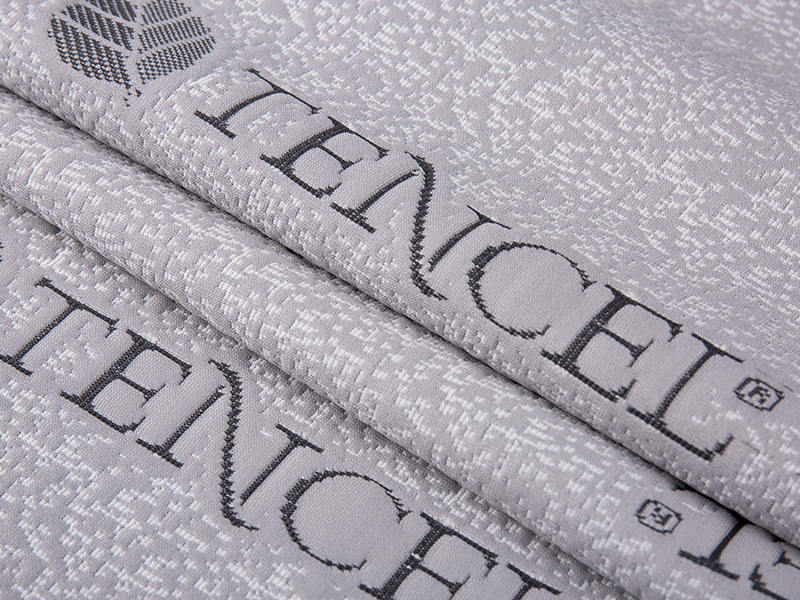 Tencel Lyocell Mattress FabricWoven from wood-pulp cellulose, Tencel ticking offers a smooth, cool hand and hydrophilic moisture management for premium covers. A natural choice here when comparing fiber options like bamboo viscose, cotton, and polyester for mid-to-high tier mattress lines.View Product →
Spec 03: WeightGSM and Weight Tolerance: The Number That Decides Cost
GSM, or grams per square meter, is the most disputed figure in mattress fabric purchasing, so fix both the target and the tolerance before a price is quoted.
Weight drifts for mundane reasons: a yarn substitution, a gauge change, or a finishing shrink nobody re-measured. Fabric running 30 GSM light can stretch thin over a pillow-top build and fail inspection at final assembly, and since fabric is billed by the kilogram, drift moves cost directly. For benchmarks across fiber types, this mattress fabric GSM guide on quality and durability is a practical cross-check before you fix a target.
Spec 04: ConstructionKnitted or Woven: Construction Sets Stretch and Surface
Construction decides how the cover behaves on the mattress line: knits stretch over foam profiles, while woven jacquards hold crisp patterns and firm edges.
Knitted ticking
- Stretches cleanly over pillow-top and euro-top builds
- Elasticity hides minor foam irregularities
- Typically 200-320 GSM
- Suits solid colors and printed programs
Woven jacquard
- Patterns are woven in, so they resist fading and crushing
- Dimensional stability suits borders and panels
- Typically 280-420 GSM
- Signals the premium visual tier on the floor
Pattern repeat is the hidden cost. Repeat width that mismatches the cut panel width forces the cutting room to break pattern, and consumption can climb by high single digits, so agree repeat size in centimeters alongside GSM.
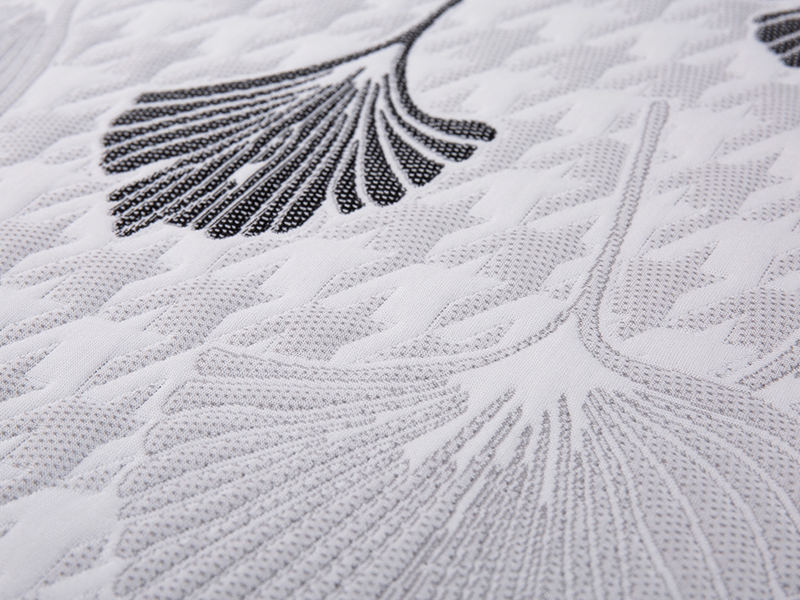 Jacquard Mattress FabricWoven on looms with individual warp control, jacquard fabric integrates color through yarns rather than inks, giving reversible patterns without surface degradation. Relevant before agreeing pattern repeat sizes, since repeat width directly affects cutting-room consumption and final quote.View Product →
Spec 05: FinishesFunctional Finishes: Cooling, Waterproofing, and Smart Fibers
Functional finishes turn commodity ticking into a sellable feature, but every claim needs a test method attached before it goes on a label.
- Cool touch: graded by Qmax, the instantaneous contact heat flux, where 0.15 W/cm2 is the common benchmark for a contact-cool claim under the GB/T 35263 test method
- Temperature regulating: specialty yarns buffer temperature swings for hot sleepers
- Graphene infused: positioned for antimicrobial, antistatic, and far-infrared claims
- Waterproof lamination: membrane-backed fabrics for baby mattresses that survive repeated machine washing
- Breathable mesh: 3D structures that keep infant cot surfaces ventilated
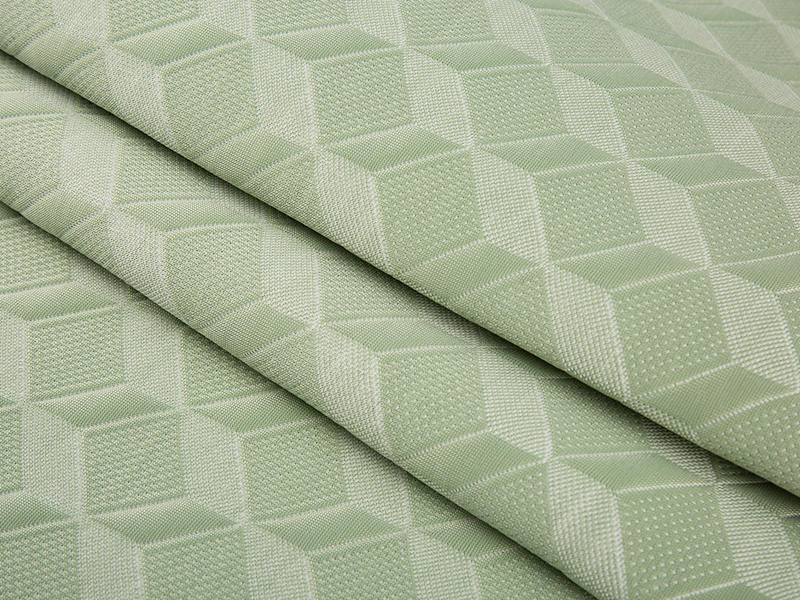 Cool Touch Mattress FabricMade with HDPE or mica-infused yarns, cool touch fabric conducts heat away on contact, with Q-max values well above standard cotton. A strong option when functional finishes add sellable features to mattress covers, provided each claim carries a test method.View Product →
Spec 06: ComplianceCompliance Paperwork OEM Buyers Cannot Skip
Missing certificates block shipments faster than poor stitching, so audit the mill's paperwork before the first deposit leaves your account.
- Oeko-Tex Standard 100 on the finished fabric, upgraded to Class I where the line serves babies
- EU REACH conformity covering restricted substances in dyes and finishes
- Flammability evidence matched to destination: 16 CFR Parts 1632 and 1633 for the United States, BS 7177 or EN 597 for the UK and Europe
- ISO 9001 certified quality management at the mill, not just in a brochure
- Batch test reports tied to the lot you actually receive, dated within the production window
Spec 07: ProcessFrom Tech Pack to Bulk Roll: Running the Sampling Process
A four-stage sampling process is what separates a smooth bulk delivery from a container full of arguments.
- Lock the tech pack. Fiber, GSM, construction, repeat, finish, color reference, and packaging agreed in one signed document.
- Approve the lab dip. Color confirmed on the actual substrate, usually within one to two weeks.
- Test hand feel over your quilt. Fabric behaves differently quilted to foam than it does as a flat swatch.
- Run a pilot with inline checks. Verify GSM on the line, confirm label claims, then release bulk production.
Suppliers that integrate design, weaving, and finishing keep these loops short. RongLi, founded in 1989, runs jacquard, printed, dyed, yarn-dyed, and knitted production on weaving machines imported from Germany and Italy, and exports to Europe, the United States, Southeast Asia, the Middle East, Japan, and Korea. Its custom mattress fabric catalog spans ticking, cooling covers, and baby fabrics, which makes side-by-side supplier comparison straightforward.
Buyer FAQFrequently Asked Questions
What GSM should I specify for custom mattress ticking?
Most knitted ticking programs sit between 200 and 320 GSM, while woven jacquard panels typically run 280 to 420 GSM and baby fabrics stay lighter at 120 to 200 GSM. Fix the target for your build, then attach a +/- 5 percent tolerance so every roll can be checked against it.
Which certifications are non-negotiable when sourcing OEM fabric?
Oeko-Tex Standard 100 and EU REACH conformity form the chemical-safety baseline, with Class I applying to baby products. Add destination flammability evidence, such as 16 CFR Parts 1632 and 1633 for the United States or BS 7177 for the UK, and confirm the mill runs ISO 9001 certified quality management.
How many sampling rounds should I expect before bulk production?
Plan for two to three rounds: a lab dip for color, a loom or hand-feel sample tested over your quilt build, and a pre-production or pilot run. Each round should end with a signed, dated approval so the reference for bulk is never ambiguous.
Can one mill supply both cooling and waterproof fabric programs?
Yes, when the mill handles functional yarns and lamination in-house. RongLi lists cool touch, temperature-regulating, graphene, and waterproof baby fabrics within one mattress fabric portfolio, which simplifies testing, ordering, and consolidated shipping.