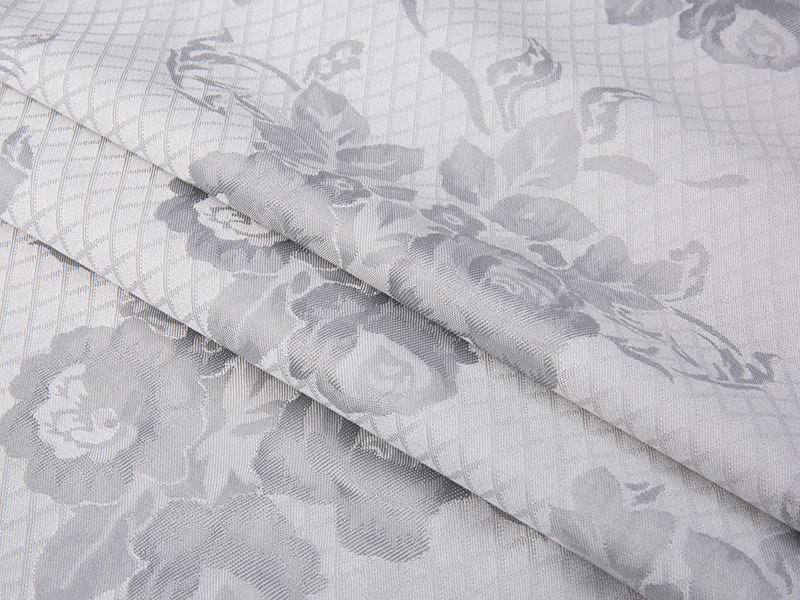
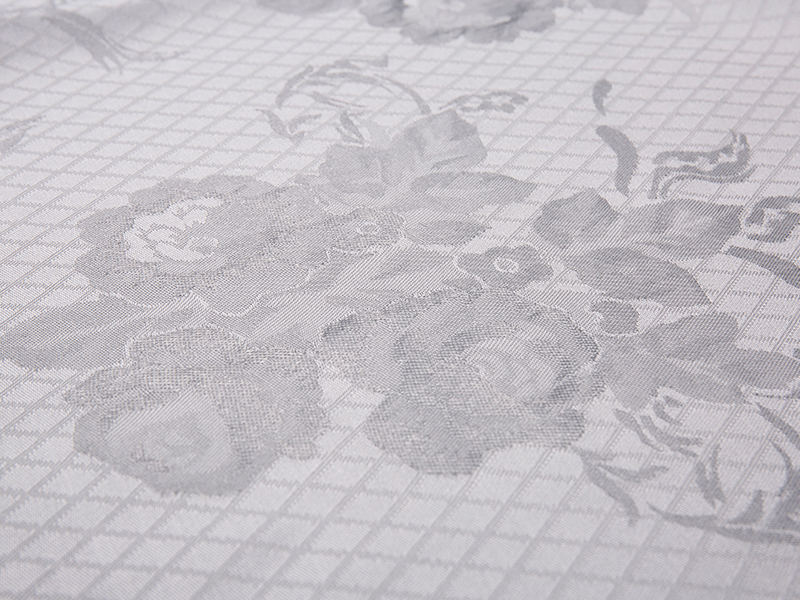
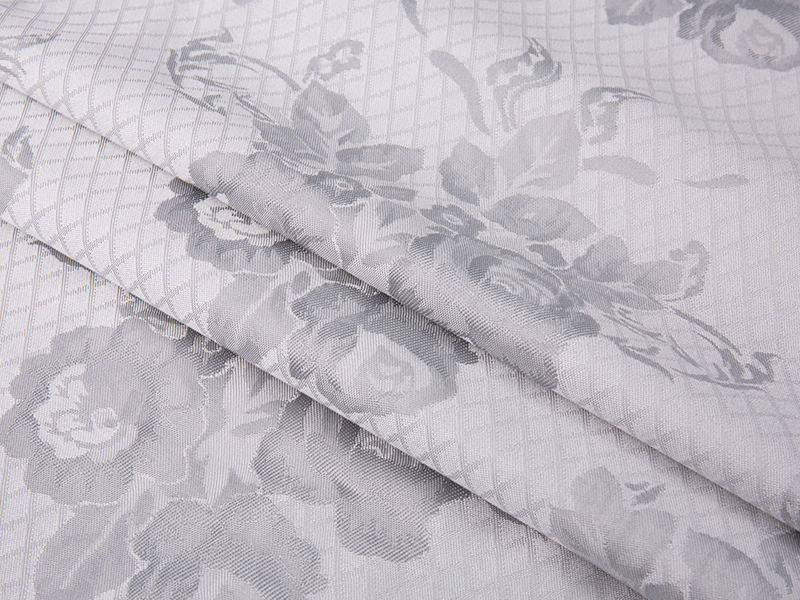
Custom Woven jacquard fabric

Home / Products / Sustainable Mattress Fabrics / Woven jacquard fabric

Woven jacquard fabric Manufacturers

Electronic Jacquard Multi-weave System

Woven Jacquard Mattress Fabric

Woven jacquard mattress fabric is manufactured on electronic jacquard looms equipped with 2,688 to 12,288 individual hook mechanisms, each controlling a single warp end. This technology enables independent yarn positioning per pick, producing structural patterns with unlimited repeat size—distinct from dobby looms which are limited to 28-40 frame patterns. The weave architecture uses two or three yarn systems: ground warp (typically 40s-80s combed cotton or polyester), pattern weft (textured or air-jet polyester), and sometimes a backing warp for double-face constructions. Pattern formation occurs through differential yarn tension and interlacing density rather than surface printing or coating. The resulting textile has measurable thickness variation between raised pattern zones (0.8-1.2 mm) and background field (0.4-0.6 mm). Warp density ranges from 80 to 160 ends per cm depending on pattern complexity.

Weave Architecture

Loom ConfigurationJacquard + Cam motion multi-weave
Hook Capacity2,688 / 5,376 / 12,288 (selector)
Weave StructuresSatin / Twill / Crepe / Herringbone combinations
Pattern RepeatUnlimited (full width, full roll length)
Yarn Feed Rate800-1,200 m/min (depending on pattern density)

Material Platform

Warp Yarns
Combed cotton (40s-80s) / rPET filament / TENCEL
Weft Yarns
Air-jet textured polyester / viscose / blended
Pattern Contrast
Matte vs semi-dull filament differential
Auxiliary Inputs
Elastic yarns (spandex covered) for stretch zones

Physical Parameters

Finished Weight180 – 450 gsm (pattern-dependent)
Thread Count300 – 800 TC (woven construction)
Thickness range0.45 – 1.30 mm (pattern relief area)
Warp ends per cm80 – 160
Weft picks per cm60 – 140

Structural Advantages

1
Pattern depth visibility from 3 meters distance; surface relief measurable 0.3-0.7 mm between pattern and ground.
2
Biaxial tensile strength differential ≤ 15% (warp vs weft) using balanced weave construction.
3
Abrasion resistance 35,000-50,000 cycles Martindale; pattern integrity maintained through wear.
4
No pattern migration or surface peeling; design embedded within yarn interlacing.

Application Mapping

Luxury Hotel Bedding
Brand-specific pattern registration for 5-star property mattress ticking.
Designer Mattress Collections
Retail differentiation through proprietary woven patterns.
Contract Upholstery
Headboard panels and bed frames requiring coordinated textile surfaces.
Heritage & Traditional Lines
Damask and brocade-style motifs for classic bedding collections.

Production Specifications

Warp beam capacity1,800 – 2,400 meters per beam
Fabric roll width160 – 280 cm (loom width, finished trimmed 2-5% loss)
Color registration4-6 color maximum per pattern (yarn dyed)
Lead time (pattern development)15-25 working days for punch card / electronic file conversion

Technical Risk Mitigation

Float length snagging Ground weave modified with additional binding points; float length reduced from 8 to ≤4 ends per pattern element.
Differential shrinkage Stenter frame heat setting (190°C, 18 m/min) with overfeed 2-3% equalizes warp/weft tension differential.
Pattern alignment at seams CAD pattern repeat markers printed on selvedge; cutting machine laser registration ≤ 1.5 mm tolerance.

Care Protocol

Wash40°C, gentle cycle. Load ≤ 70% drum capacity to prevent pattern creasing.
ChemistryNeutral detergent (pH 6.0-7.5). No optical brighteners which alter contrast between matte/semi-dull zones.
DryLow heat ≤ 55°C or line dry. Remove promptly to set pattern geometry.
IronReverse side, 150°C max. Use pressing cloth to avoid flattening raised weave elements.

Compliance

OEKO-TEX Standard 100 (Product Class I or II)
REACH SVHC compliant (all dyestuffs and auxiliaries)
Flammability: BS 5852 crib 5 / CA TB 117-2013
GRS certification available for recycled content variants (≥30% rPET)
About Us
image front
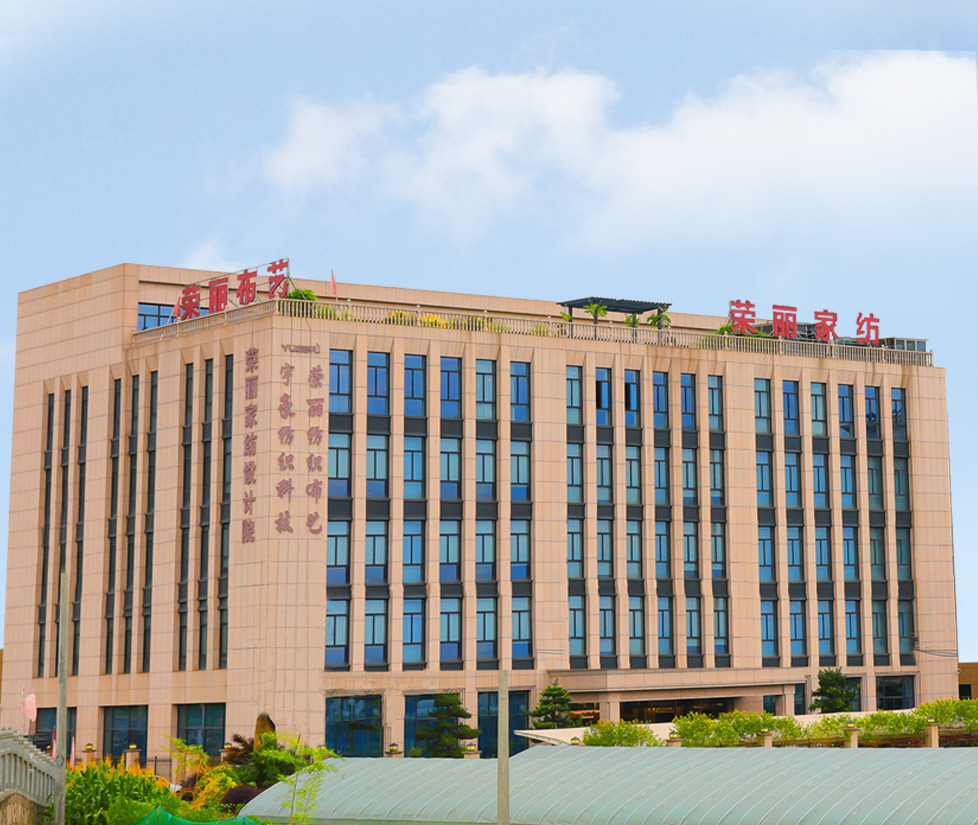
Hangzhou Xiaoshan RongLi Clothing Co.,Ltd.

Hangzhou Xiaoshan RongLi Clothing Co.,Ltd. was established in 1989 and has been a professional company dedicated to modern mattress fabric. Our company covers 100000 ㎡, and has been honored with "AAA enterprise" of Hangzhou enterprise credit rating, "Xiaoshan brand products", and "Hangzhou famous brand" of our "Rongli trademark". Meanwhile, our company has passed ISO9001:2000 quality system accreditation and all our fabrics have passed the inspection of EU REACH and accreditation of German Hein Stan Oeko-TexStand100.xStand100 certificate.

We are China Woven jacquard fabric Manufacturers and Custom ODM/OEM Woven jacquard fabric Factory. Our company integrates mattresses, design, production, R&D, and sales of home textiles, and imports advanced waving machinery from West Germany and Italy, among others. Produced jacquard, printed, dyed, and color-dyed fabric, knitting mattress, tatting materials, and thermal transfer printed material are of fashionable style and have wide varieties. Knitted and printed tatting cloths are widely applied to cushions, mattresses, pillow covers, sofas, and the manufacturing of thermally transferred printed fabrics. At present, our products are not only sold to all major cities but also sold to countries and regions such as Europe, America, South-East Asia, the Middle East, Japan, and Korea, enjoying a good reputation at home and abroad and are very popular among customers.

News
Woven jacquard fabric Industry knowledge
Product Range & Application Engineering

Woven jacquard fabric

Hangzhou Xiaoshan RongLi Clothing Co., Ltd. is a Woven jacquard fabric manufacturer serving industrial projects that require a defined process window, reliable integration and a documented technical scope.

Our approach connects the product configuration with the workpiece, production target, quality requirement and automation plan. The resulting scope covers the main equipment, line interfaces, acceptance basis and lifecycle support needed for a coordinated installation.

Configured Around the Application

We define the configuration around the required operation, material grade, workpiece dimensions, processing sequence, tolerance and output per shift. Product variety and changeover frequency are also incorporated because they affect capacity margin, tooling, controls, access and automation level.

Our technical proposal states the sizing assumptions and normal operating range instead of relying only on a theoretical maximum. Drawings, representative samples and process-trial data allow the product and tooling arrangement to be aligned before configuration approval.

Technical Scope and Configuration

The technical scope can cover rated capacity, working range, stroke or travel, speed, usable work area, clearance, accuracy, repeatability, rigidity, drive and control architecture, power requirements and compatible tooling. We distinguish rated values, adjustable ranges and configuration-dependent performance in the proposal.

  • Performance is matched to the intended working point, not only to a headline maximum.
  • Our scope identifies included equipment, optional equipment and site-supplied interfaces.
  • Drawings, layout data and utility requirements support project planning.
  • Control language, data interfaces, recipes, traceability and line communication are defined for the application.

Automation, Safety and Site Integration

The base machine or product is one part of the complete installation. Our integration scope can account for feeding, transfer, tooling, guarding, sensors, conveyors, lubrication, scrap handling, inspection and connected equipment, with physical interfaces, signals and commissioning responsibilities defined in an interface document.

Safety provisions are aligned with the destination market and plant requirements. The documented scope identifies guards, interlocks, emergency-stop circuits, risk-reduction features and conformity documents applicable to the delivered configuration.

Quality Control and Acceptance

Our project scope connects critical-component selection, fabrication, assembly, inspection and pre-shipment testing with the agreed specifications. Factory acceptance conditions can define the test material, operating duration, measurement method and records supplied with the equipment.

Relevant factory resources, quality records, technical drawings and change-control documents provide a practical basis for technical review. Certification references are applied only when their issuer, scope and validity match the delivered configuration.

Application and Project Matrix

Project Area Application Information Our Technical Output
Application fit Material, part drawing, process and output target Sizing calculation and recommended configuration
Acceptance Measured tolerances, test duration and sample Inspection plan and FAT record
Lifecycle support Shift pattern, maintenance resources and destination Service scope, manuals and spare-parts plan

Total Cost, Delivery and Lifecycle Support

Our proposal can separate the base product, tooling, options, auxiliary equipment, packaging, delivery documents, installation, commissioning, training and initial spare parts. It also defines delivery terms, production milestones, approval points and the effect of approved changes on price or lead time.

Lifecycle support considers energy use, consumables, lubrication, wear parts, maintenance access, diagnostics, software and spare-parts availability. Maintenance intervals, recommended spares, warranty boundaries and available remote or on-site support can be documented for the destination country.

Information We Use to Configure Your Solution

  • Part drawing, material specification, dimensions and tolerance requirements
  • Process sequence, tooling information and representative samples
  • Target cycle rate, shifts per day, annual volume and planned capacity margin
  • Required configuration, automation level and line interfaces
  • Destination voltage, frequency, utilities, floor space and environmental conditions
  • Safety, documentation, certification and language requirements
  • Inspection method and factory/site acceptance criteria
  • Packaging, delivery terms, installation, training and service expectations
  • Requested spare-parts package, warranty terms and quotation validity

Related Equipment Categories

Compare Jacquard mattress fabric when the application requires a different frame, working area, drive arrangement or automation level.

A Configuration Built Around Your Project

Share the application details above with Hangzhou Xiaoshan RongLi Clothing Co., Ltd.. We will connect each major configuration choice to the production requirement and prepare a proposal that separates standard scope, options, site responsibilities and items requiring technical confirmation.