 English
 русский
 Español
 中文简体
中文简体
Article Directory
- 1 I. The Technical Demand for Sleep Microclimate Control
- 2 II. Yarn Science: Enhancing Intrinsic Moisture Management
- 3 III. Knit Structure Engineering for Ventilation
- 4 IV. Validation of Microclimate Control
- 5 V. Manufacturing and B2B Quality Assurance
- 6 VI. Conclusion
- 7 VII. Frequently Asked Questions (FAQ)
- 7.1 1. What makes the Tencel blend knitted jacquard mattress fabric breathability superior to standard polyester?
- 7.2 2. What is the main structural advantage of a 3D knitted jacquard structure for mattress ventilation?
- 7.3 3. How does the choice between double knit vs single knit jacquard for mattress covers affect durability?
- 7.4 4. What specific metric should be used according to the B2B guide to moisture wicking mattress fabric testing?
- 7.5 5. What are the key features required by Coolmax moisture management mattress ticking specifications?
I. The Technical Demand for Sleep Microclimate Control
The primary function of a high-quality knitted jacquard fabric for mattress is to serve as the critical interface between the sleeper and the mattress core. Its performance in moisture absorption, wicking, and heat dissipation directly determines the stability of the sleep microclimate, minimizing night sweats and thermal discomfort. For B2B procurement, specifying fabrics that excel in these metrics is crucial for market competitiveness.
Since our establishment in 1989, Hangzhou Xiaoshan RongLi Clothing Co., Ltd. has specialized in modern mattress fabric. Honored with "AAA enterprise" and holding quality management system accreditation and German OEKO-TEX Standard 100 accreditation, we integrate design, production, R&D, and sales to deliver fabrics that meet stringent global standards, including European Union chemical safety requirements.
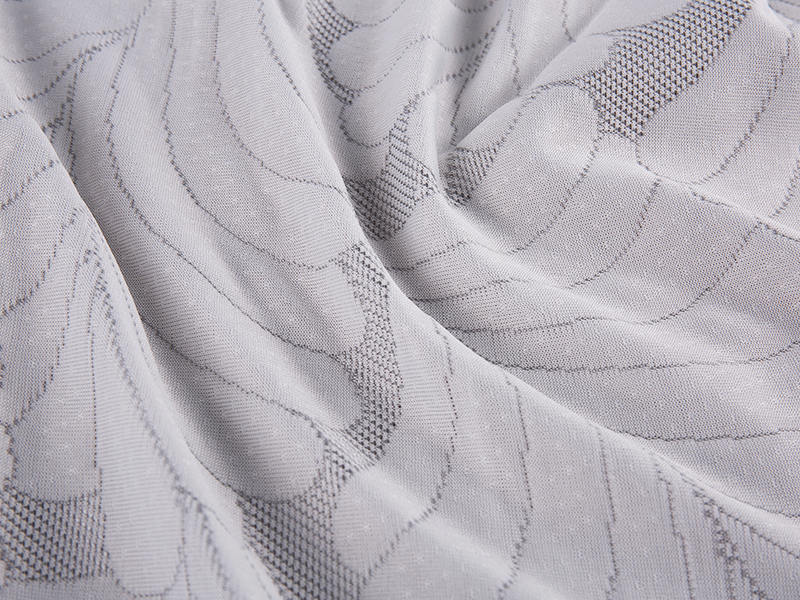
II. Yarn Science: Enhancing Intrinsic Moisture Management
The choice of yarn fundamentally dictates the fabric's ability to handle moisture. Combining high-performance fibers with the aesthetic versatility of the jacquard knit structure is key.
Advanced Fiber Functions
When analyzing Tencel blend knitted jacquard mattress fabric breathability, the Lyocell fiber (Tencel) stands out due to its superior moisture absorbency. Unlike polyester, Tencel absorbs moisture vapor directly into the fiber structure, offering a natural cooling effect through evaporative heat loss. Conversely, Coolmax moisture management mattress ticking specifications rely on engineered polyester fibers with specialized cross-sections to quickly wick moisture away from the body and disperse it for rapid evaporation on the surface.
The selection process requires a technical trade-off: natural absorption for sustained cooling (Tencel) versus synthetic wicking for rapid drying (Coolmax). A blend often provides the optimal balance.
Performance Metrics of Key Functional Yarns for Mattress Fabric
| Yarn Type | Primary Mechanism | Moisture Management Performance | Thermal Sensation |
|---|---|---|---|
| Tencel (Lyocell) | Absorption & Evaporation | High absorption, excellent wicking | Naturally Cool-to-the-Touch |
| Coolmax/Engineered Polyester | Capillary Wicking | Rapid surface drying, low absorption | Neutral to Cool, depending on finish |
| Standard Polyester/Cotton | Limited Wicking/High Absorption | Poor to Moderate | Warm/Insulative (Cotton retains moisture) |
III. Knit Structure Engineering for Ventilation
The physical structure of the knitted jacquard fabric for mattress controls air circulation and bulk, which affects both comfort and heat retention.
Structure and Bulk
B2B buyers must compare the structural properties, such as in the double knit vs single knit jacquard for mattress covers. Single knit jacquard is lighter and inherently more breathable but offers less resilience and structure. Double knit jacquard, created using imported advanced weaving machinery, offers superior dimensional stability, resilience, and a plusher feel, often preferred for high-end mattress surfaces. However, its increased bulk can initially reduce air permeability unless offset by structural design elements.
The emergence of the 3D knitted jacquard structure for mattress ventilation represents a technical leap. This structure acts as a spacer fabric, utilizing two separate face fabrics connected by monofilament yarns. This creates an internal micro-airflow channel, which actively facilitates ventilation and prevents heat buildup near the body, offering a superior balance of pressure distribution and cooling.
Knit Structure Properties for Mattress Covers
| Knit Structure | Dimensional Stability/Resilience | Air Permeability (Relative) | Typical Application |
|---|---|---|---|
| Single Knit Jacquard | Moderate (Prone to curling) | High (Lighter fabric) | Cushions, lower-profile mattresses. |
| Double Knit Jacquard | Very High (Plush, robust) | Moderate (Requires engineered yarn) | Premium mattress ticking (most common). |
| 3D Knitted Jacquard (Spacer) | High (Excellent pressure relief) | Very High (Internal airflow channels) | Breathable core layers, high-end ticking. |
IV. Validation of Microclimate Control
Claims of superior performance must be backed by technical testing. For knitted jacquard fabric for mattress, the focus is on moisture vapor resistance and wicking speed.
Testing Protocols
A comprehensive B2B guide to moisture wicking mattress fabric testing requires quantifying the fabric's performance using American Society for Testing and Materials or American Association of Textile Chemists and Colorists standards for wicking and drying rate. Most importantly, the fabric's evaporative cooling capacity is measured by the Ret (Resistance to Evaporative Heat Transfer) value. A lower Ret value confirms that the fabric efficiently allows sweat vapor to pass through, reducing the humid layer (or microclimate) near the skin.
RongLi ensures all our fabrics have passed the inspection of European Union chemical safety requirements and the accreditation of German OEKO-TEX Standard 100, providing B2B buyers with confidence in the safety and ecological compliance of our materials.
V. Manufacturing and B2B Quality Assurance
Our commitment to quality is upheld by importing advanced weaving machinery from West Germany and Italy. This high-precision equipment is essential for producing the complex patterns and tight tolerances required for high-performance knitted jacquard fabric for mattress, especially for 3D knitted jacquard structure for mattress ventilation.
RongLi's comprehensive capacity, integrating all stages from design to R&D, allows us to provide wide varieties of knitted jacquard, printed, and dyed fabrics. Our products are popular across Europe, America, South-East Asia, the Middle East, Japan, and Korea, demonstrating our ability to meet diverse international specification demands. We stick to the managing conception of "Technology, innovation, honesty and development" to provide better service to customers.
VI. Conclusion
The optimal knitted jacquard fabric for mattress is achieved through the synergy of material science and structural engineering. By utilizing the moisture-absorbing properties of Tencel blend knitted jacquard mattress fabric breathability and the rapid wicking of Coolmax moisture management mattress ticking specifications, combined with the air circulation capacity of advanced structures like the 3D knitted jacquard structure for mattress ventilation, manufacturers can guarantee a balanced sleep microclimate, a key driver for premium mattress market success.
VII. Frequently Asked Questions (FAQ)
1. What makes the Tencel blend knitted jacquard mattress fabric breathability superior to standard polyester?
Tencel (Lyocell) is a natural cellulosic fiber that absorbs moisture directly into its core, actively cooling the body through evaporation. Standard polyester is hydrophobic and relies solely on wicking surface moisture, which is less effective for deep moisture regulation, making the Tencel blend a premium choice.
2. What is the main structural advantage of a 3D knitted jacquard structure for mattress ventilation?
The main advantage is the creation of an internal, open airspace (spacer structure) between the two outer fabric layers. This acts as a ventilation chimney, allowing constant airflow that dissipates heat and moisture vapor away from the sleeper, leading to superior microclimate control.
3. How does the choice between double knit vs single knit jacquard for mattress covers affect durability?
Double knit jacquard is significantly more durable and dimensionally stable than single knit. The interconnected loops in the double knit structure provide higher resilience, superior edge retention, and less risk of pilling or tearing, making it the preferred choice for long-term mattress ticking.
4. What specific metric should be used according to the B2B guide to moisture wicking mattress fabric testing?
The most crucial metric for quantifying overall thermal and moisture management is the Ret value (Resistance to Evaporative Heat Transfer). A low Ret value confirms high breathability and effective moisture vapor transport, which is a direct measure of microclimate control capacity.
5. What are the key features required by Coolmax moisture management mattress ticking specifications?
Key specifications include the use of polyester fibers with a specialized four- or six-channel cross-section. This unique shape creates large surface areas for rapid capillary action (wicking) and faster dispersal, ensuring the fabric surface dries quickly and maintains a non-clammy feel.