 English
 русский
 Español
 中文简体

Article Directory
- 1 What Mattress Ticking Fabric Has to Deliver
- 2 Fiber Selection Sets the Ceiling on Every Other Spec
- 3 GSM, Width, and Construction Decide the Fit
- 4 Compliance Documents That Clear Customs and Retail Audits
- 5 Physical Performance Thresholds and How to Test Them
- 6 Supplier Capability: Scale, Lead Time, and MOQ
- 7 Cost Structure and Landed Cost
- 8 Building the Ticking Specification Sheet
- 9 Practical Decisions That Shape a Ticking Order
A 1,000-piece mattress production run consumes roughly 2.5 to 4 meters of 210 cm wide ticking per unit, which puts total fabric demand between 2,500 and 4,000 meters. If that roll shrinks 3 percent in the first production wash and nobody tested for it beforehand, the loss is 75 to 120 meters of unusable cut panels plus the labor already spent on them.
Ticking is the largest textile line in most mattress bills of materials, and every decision that determines whether it performs is made at the specification stage, months before the cutting table. The factors below move cost, compliance, and repeat-order consistency.
What Mattress Ticking Fabric Has to Deliver
Mattress ticking fabric is the durable outer cover textile, woven or knitted, that wraps the mattress core and forms the sleep surface, and in the United States it must also satisfy the federal flammability standard 16 CFR Part 1633.
Definition: ticking is the exposed outer cover of a mattress, supplied in roll form at widths from 210 cm to 300 cm and specified by fiber content, construction type, and grams per square meter (GSM). It is not the same product as a quilting substrate, which sits beneath the ticking and never touches the consumer.
Six measurable demands drive every ticking specification. A fabric that fails any one of them generates claims at retail rather than at the factory gate.
- Abrasion resistance: 15,000 or more Wyzenbeek double rubs to ASTM D4157 without visible fiber breakdown.
- Tensile and tear strength: survives being pulled over high-density foam and spring units during the tape-edge process.
- Dimensional stability: holds within 3 percent in both warp and weft after three home launderings at 40 degrees Celsius.
- Colorfastness: grade 4 or better to crocking, perspiration, and laundering.
- Pilling resistance: grade 4 retained after 2,000 Martindale rubs.
- Chemical compliance: passes OEKO-TEX Standard 100 at the applicable product class with no REACH SVHC above 0.1 percent by weight.
Fiber Selection Sets the Ceiling on Every Other Spec
Fiber content typically accounts for 50 to 70 percent of the delivered ticking price, and it caps what you can achieve on abrasion, hand feel, and moisture behavior.
Combed cotton remains the reference point for hand feel and quilting compatibility, but the cost index of 100 makes it the most expensive option per meter in a plain construction. Polyester drops that index to roughly 70 while raising abrasion resistance. Lyocell and organic cotton push the index above 130, which only makes sense when the retail claim supports the premium.
| Fiber | Cost index | Hand feel | Durability | Certification route |
| Combed cotton | 100 | Dry, natural | Moderate | OEKO-TEX Standard 100 |
| Polyester, spun or filament | 70 | Smooth, synthetic | High | OEKO-TEX, GRS if recycled |
| Lyocell | 135 | Cool, fluid | Moderate | OEKO-TEX, chain of custody |
| Bamboo viscose | 110 | Silky, cool | Low to moderate | OEKO-TEX Standard 100 |
| Organic cotton | 150 | Dry, natural | Moderate | GOTS plus OEKO-TEX |
| Cotton and polyester blend | 85 | Balanced | High | OEKO-TEX Standard 100 |
Lyocell deserves a closer look because it behaves differently from cotton and polyester in the same quilting line. Its moisture regain sits above cotton while its dry strength stays comparable to polyester, which lets a brand claim a cooler surface without changing the quilting parameters.
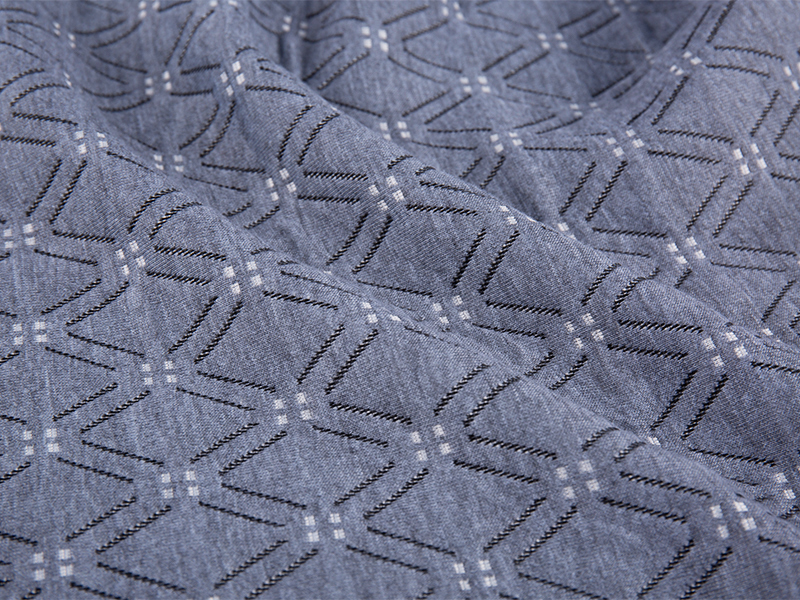
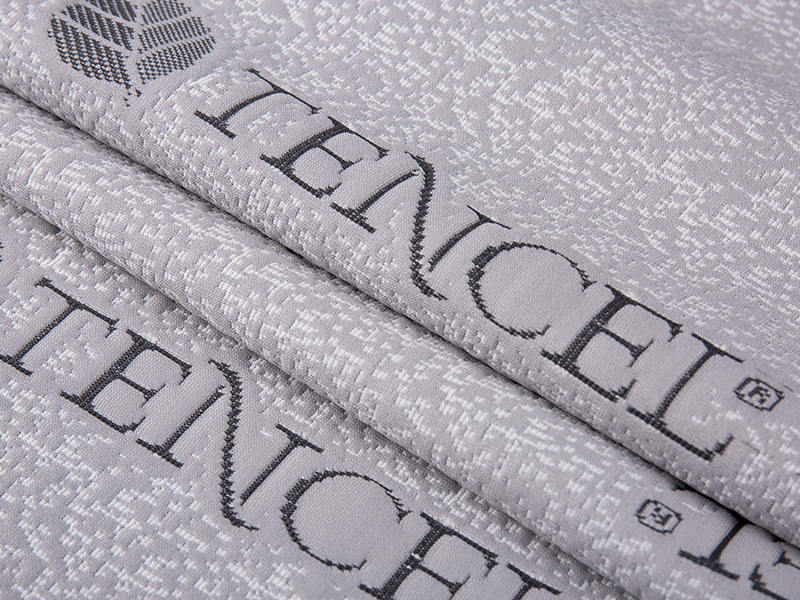 Custom Tencel Lyocell Mattress FabricThis Lyocell ticking combines moisture regain above cotton with dry strength near polyester, making it worth reviewing for cooler quilted mattress surfaces.View Product →
GSM, Width, and Construction Decide the Fit
Commercial ticking programs typically specify 180 to 450 GSM, with woven jacquard constructions clustering between 260 and 380 GSM and knitted ticking running 220 to 400 GSM.
Typical production GSM ranges by ticking construction
Bar length reflects the upper bound of each GSM band.
GSM is not a quality score on its own. A 320 GSM knitted ticking and a 320 GSM woven jacquard behave completely differently once the quilting needle hits them, because weight per square meter says nothing about how the yarns are bound.
Woven jacquard ticking
- Higher dimensional stability, so cut panels stay square through quilting.
- Better abrasion resistance at equal fiber content.
- Limited stretch, which suits tight tape-edge and border construction.
- New pattern tooling raises the minimum order per design.
Knitted ticking
- Stretch and recovery accommodate thicker foam cores.
- Softer hand at a lower GSM, so less material buys more comfort.
- Faster pattern changeover and lower minimums per colorway.
- Higher pilling and snagging risk if yarn selection is loose.
Width determines waste as much as price. A 210 or 215 cm roll covers most queen and king top panels with the least trim loss, while 240 cm and 280 to 300 cm rolls suit double-wide quilting lines and border cutting. RongLi runs both 210 cm and 215 cm widths as standard, which matches the top-panel geometry used by most US and EU mattress makers. Buyers who need a heavier knit can review 450 GSM knitted mattress fabric as a reference point for the upper end of the range.
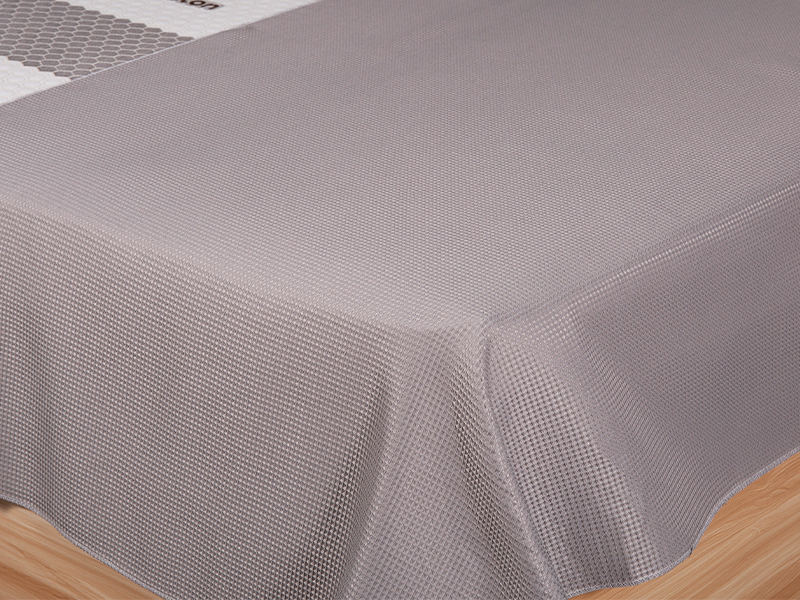
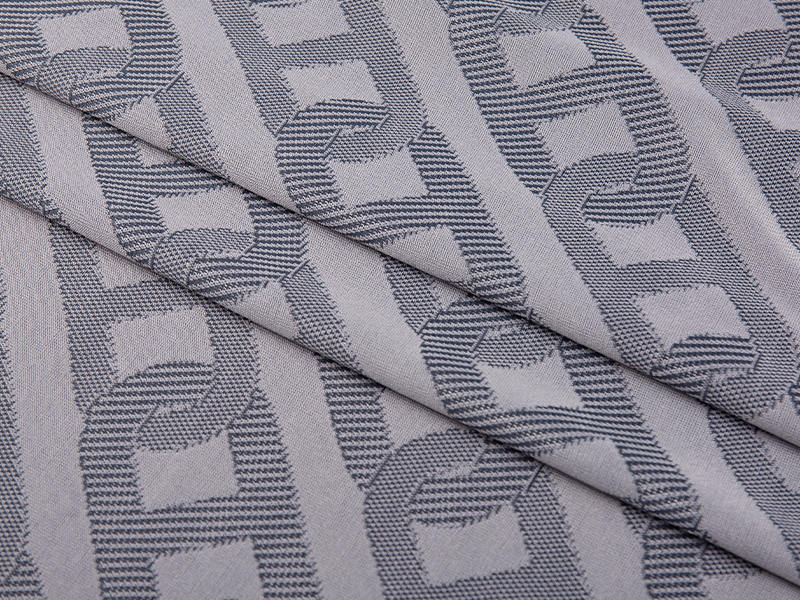
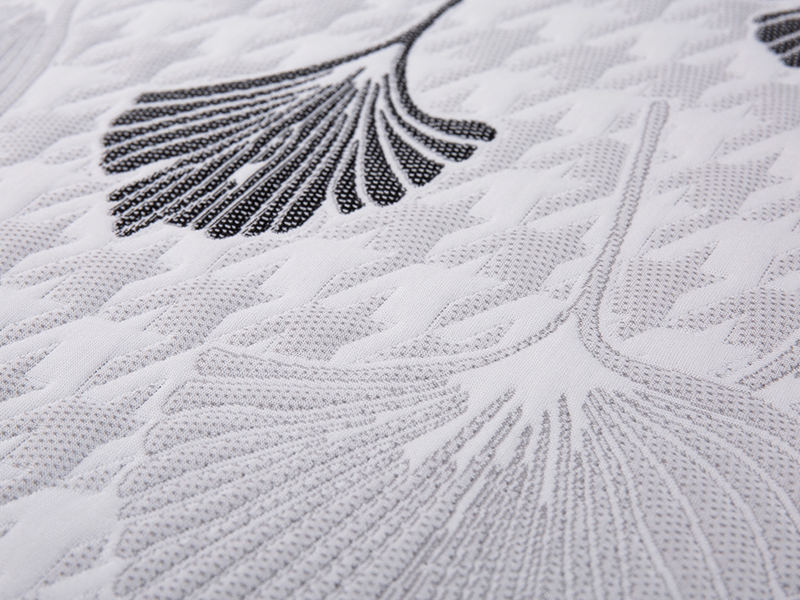 Custom Jacquard Mattress Fabric CK-235 TickingThis reversible woven jacquard ticking offers two-sided patterns and 215 cm width, making it worth checking for top-panel cutting and compliance documentation.View Product →
Compliance Documents That Clear Customs and Retail Audits
Three document types clear most retail and customs gates: an OEKO-TEX Standard 100 certificate issued at the correct product class, a REACH SVHC declaration, and a flammability test report to 16 CFR Part 1633 or BS 7177.
- OEKO-TEX Standard 100 certificate naming the exact article code, with product class I required for infant bedding and class II for articles worn against the skin.
- REACH SVHC declaration against the current candidate list at the 0.1 percent weight-by-weight threshold, plus Annex XVII entry 43 for azo dyes.
- Flammability report to 16 CFR Part 1633 for the US market, or BS 7177 and BS 5852 for the United Kingdom.
- GOTS or Organic Content Standard transaction certificate for any organic cotton claim, and Global Recycled Standard certification for recycled polyester content.
- CPSIA third-party test report when the ticking ends up in a children's product sold in the United States.
Certificate scope matters more than the certificate logo. A mill that holds OEKO-TEX approval on a white polyester ground cannot extend that claim to a dyed jacquard running different yarns, so always confirm the certificate lists the article number you are ordering.
Hangzhou Xiaoshan RongLi Clothing Co., Ltd., founded in 1989, holds ISO 9001:2000 certification and runs all fabrics through EU REACH testing alongside OEKO-TEX Standard 100 approval. Buyers who want to review the certificate framework first can check Oeko-Tex approved sleep fabrics for the documentation structure used across the range.
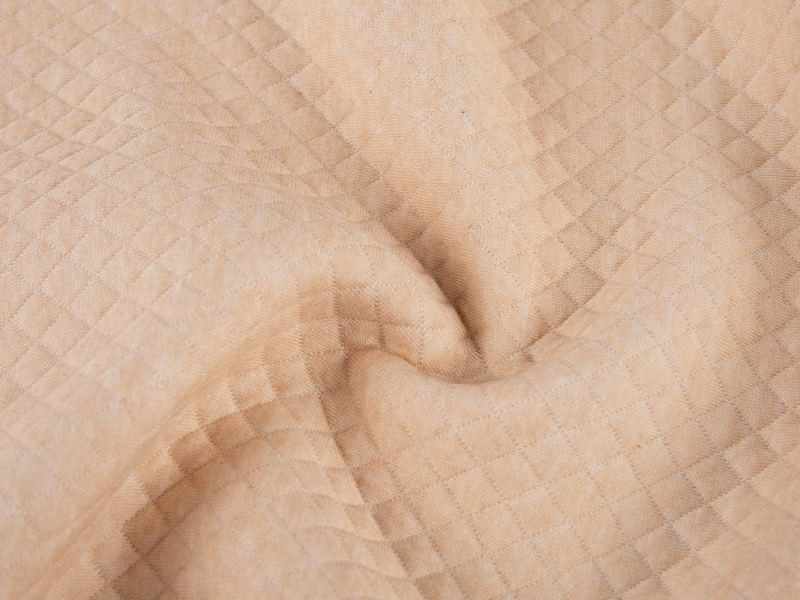
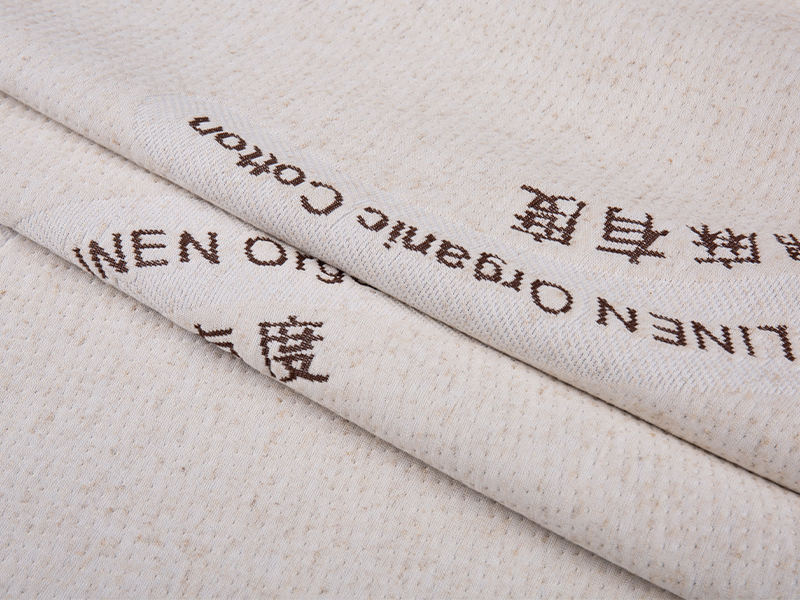 GOTS Certified Organic Cotton Mattress FabricThis GOTS-certified organic cotton ticking supports air circulation and hypoallergenic contact, making it worth reviewing for mattress specifications with documented test thresholds.View Product →
Physical Performance Thresholds and How to Test Them
Every ticking specification should name a test method and a numeric threshold, because a requirement written as good abrasion resistance cannot be enforced in a lab or a claim dispute.
| Property | Test method | Typical acceptance threshold |
| Abrasion, Wyzenbeek | ASTM D4157 | 15,000 double rubs minimum |
| Abrasion, Martindale | ASTM D4966 | 20,000 cycles |
| Tensile strength | ASTM D5034 | 250 N warp, 200 N weft |
| Tear strength | ASTM D1424 | 15 N minimum |
| Pilling resistance | ASTM D4970 | Grade 4 after 2,000 rubs |
| Dimensional stability | AATCC 135 or ISO 6330 | 3 percent maximum, warp and weft |
| Colorfastness to laundering | AATCC 61 | Grade 4 minimum |
Request the raw lab report, not a summary sheet. Reports carry the laboratory name, sample identification, conditioning conditions, and test date, and those four fields are what a retail compliance team checks first.
Supplier Capability: Scale, Lead Time, and MOQ
Production scale, loom configuration, and minimum order discipline determine whether a ticking program survives its second and third order without a spec drift.
RongLi operates from a 100,000 square meter facility in Xiaoshan, Hangzhou, using imported West German and Italian weaving machinery across jacquard, printing, dyeing, yarn-dyed, knitting, lace, and thermal transfer processes. Its fabrics ship to Europe, the United States, Southeast Asia, the Middle East, Japan, and South Korea, which means the quality documentation has already been built for cross-border audits.
- Counter-sample development: 10 to 15 working days after artwork and fiber confirmation.
- Bulk weaving and finishing: 25 to 40 working days, depending on dyeing load and pattern complexity.
- Typical minimum order: 1,000 to 3,000 meters per colorway for a custom jacquard design.
- Ocean transit: 18 to 25 days to the US West Coast, 30 to 40 days to Northern Europe.
Cost Structure and Landed Cost
Fiber content accounts for 50 to 70 percent of ticking cost, with dyeing and finishing adding 15 to 25 percent, so a 10 percent fiber cost swing moves the quoted fabric price by 5 to 7 percent.
Landed cost is where most sourcing models break. A quote that lands 6 percent lower per meter but ships in 60 days instead of 30 forces additional safety stock, and carrying 60 days of ticking at typical inventory costs absorbs the entire saving. Compare quotes on a landed basis that includes freight, duty, inspection, and the working capital tied up in transit.
Building the Ticking Specification Sheet
A specification sheet that survives a factory audit contains six blocks, and leaving any one of them vague shifts the risk onto the buyer.
- Fix the construction and GSM band, for example knitted jacquard at 300 to 320 GSM, rather than naming a weight as a single number.
- State the roll width in centimeters and the roll length tolerance, typically 210 cm width with a 2 percent length variance.
- Write colorfastness, shrinkage, and pilling limits as grades and percentages tied to named test methods.
- Attach the required compliance certificates and confirm the certificate lists the exact article code being ordered.
- Define the inspection standard, such as AQL 2.5 for major defects and AQL 4.0 for minor defects, and the inspection point.
- Record the accepted counter-sample reference so both parties compare bulk production against the same physical standard.
Practical Decisions That Shape a Ticking Order
The questions below come up in nearly every first order, and the answers determine how the specification sheet gets written.
What GSM should I specify for a 300 mm hybrid mattress?
For a 300 mm hybrid core, specify 260 to 320 GSM in a knitted construction or 300 to 360 GSM in a woven jacquard. Below 260 GSM, the ticking tends to show core edges through the quilted surface on thick foam layers.
How much ticking fabric does one mattress need?
A queen mattress with a standard border consumes roughly 2.5 to 4 meters of 210 cm wide fabric. Plan 2,500 to 4,000 meters for every 1,000 units produced.
Which certification documents should be on file before a bulk order?
Four documents: OEKO-TEX Standard 100 at the correct product class, a REACH SVHC declaration at the 0.1 percent threshold, a flammability report to 16 CFR Part 1633 or BS 7177, and a GOTS or GRS transaction certificate whenever an organic or recycled claim appears on the label.
How long does custom ticking take from sample to shipment?
Budget 10 to 15 working days for counter-sample approval and 25 to 40 working days for bulk production, then add 18 to 25 days of ocean transit to the US West Coast or 30 to 40 days to Northern Europe.
Sourcing ticking comes down to converting preferences into measurable numbers: fiber index, GSM band, roll width, abrasion cycles, shrinkage percentage, and certificate scope. Buyers who write those numbers into the purchase specification get repeat orders that match the first shipment, and they get a defensible position when a retail compliance team asks for the paperwork behind a claim.