 English
 русский
 Español
 中文简体

Article Directory
- 1 Organic Cotton vs Polyester Mattress Fabric: Definitions That Drive the Spec
- 2 Performance Differences That Show Up on the Test Report
- 3 Certification, Compliance and the Cost of the Paper Trail
- 4 Where Each Fabric Wins: A Specification Matrix
- 5 Blending and Hybrid Specifications That Reduce the Trade-Off
- 6 A Six-Step Sourcing Checklist for Mattress Manufacturers
- 7 Questions That Come Up During Specification
When a mattress programme switches from a 180 gsm knitted polyester ticking to a 220 gsm organic cotton jacquard, three numbers move at once: fabric price per running metre, the certification file, and the shrinkage allowance written into the cut plan. Sourcing failures in mattress fabric rarely come from bad weaving. They come from matching the wrong fibre to the wrong end use and discovering it at the first wash test.
Organic cotton mattress fabric is a woven or knitted ticking whose cotton fibre is certified under a chain-of-custody standard such as the Global Organic Textile Standard (GOTS) or the Organic Content Standard (OCS). Polyester mattress fabric is a synthetic ticking built from polyethylene terephthalate (PET) filament or staple yarn. The gap starts with moisture: cotton holds about 8.5 percent of its dry weight in water under standard textile conditions, polyester about 0.4 percent.
Organic Cotton vs Polyester Mattress Fabric: Definitions That Drive the Spec
The two fibres diverge at the structural level first, and every downstream property follows from that. Cotton is a natural cellulosic staple with a hollow lumen and a natural twist. Polyester is an extruded thermoplastic with a smooth hydrophobic surface and higher tenacity per unit weight.
For a manufacturer, the comparison reduces to nine specifications. The ranges below reflect commercial mattress-grade fabric rather than laboratory extremes.
| Specification | Organic cotton ticking | Polyester ticking |
| Fibre origin | GOTS or OCS certified cotton | PET filament or staple yarn |
| Standard moisture regain | 8.5 percent | 0.4 percent |
| Woven ticking weight | 140 to 260 gsm | 120 to 280 gsm |
| Knitted construction weight | 220 to 400 gsm | 240 to 450 gsm |
| Shrinkage after five washes | 3 to 5 percent | 0.5 to 1.5 percent |
| Abrasion target, ISO 12947-2 | 20,000 to 30,000 rubs | 40,000 rubs and above |
| Light fastness, blue wool scale | Grade 4 to 5 | Grade 5 to 6 |
| Primary compliance file | GOTS transaction certificate, OCS scope certificate | Oeko-Tex Standard 100 report, REACH SVHC declaration |
| End of life | Biodegradable cellulosic fibre | Recyclable PET, sheds microfibres when washed |
Performance Differences That Show Up on the Test Report
Tested side by side, polyester ticking wins on abrasion and dimensional stability, and cotton ticking wins on moisture absorption and heat behaviour. Those two results explain most of the friction between a brand design team and its warranty team.
Abrasion separates them first. Under ISO 12947-2, a 240 gsm polyester knit ticking commonly runs past 40,000 Martindale rubs before yarn break-through, while a cotton ticking of similar weight lands in the 20,000 to 30,000 rub range. For hospitality and contract programmes, that difference decides whether a cover survives one refurbishment cycle or two.
Dimensional stability separates them next. An un-compacted cotton ticking can lose 3 to 5 percent of its length across the first five domestic wash cycles, while polyester stays inside 0.5 to 1.5 percent. On a 200 cm panel, 4 percent shrinkage is 8 cm of lost cover, which is enough to fail a fit test on a pocketed mattress.
Moisture is where cotton takes the lead. Its 8.5 percent regain means the fibre absorbs perspiration vapour and releases it slowly, buffering the sleeping surface in humid rooms. Polyester at 0.4 percent regain transports liquid along the yarn instead of holding it, so it dries fast but offers almost no humidity buffer.
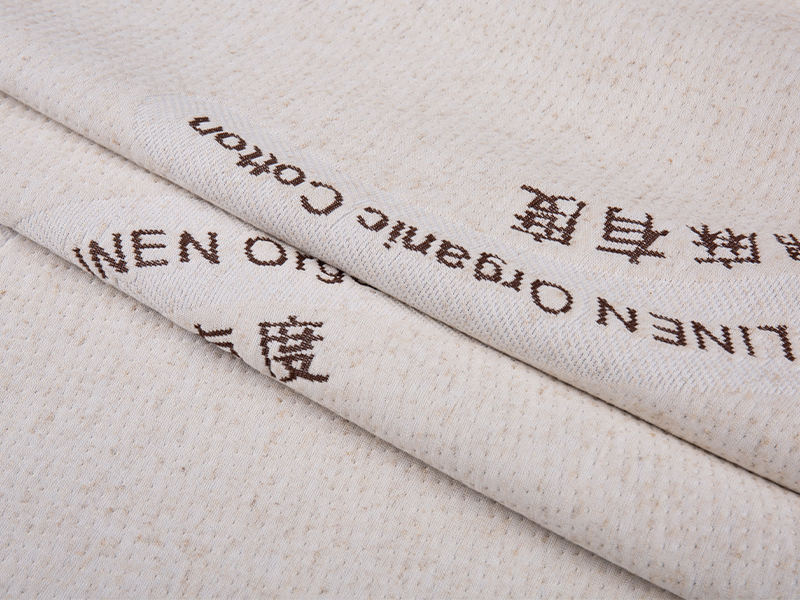 Custom Organic Cotton Mattress Fabric with GOTS TraceabilityMade through GOTS-certified supply chains and Oeko-Tex Standard 100, this organic cotton ticking supports moisture management and documented fibre traceability.View Product →
Certification, Compliance and the Cost of the Paper Trail
Organic cotton adds a fibre chain-of-custody file; polyester adds a chemical safety file. Both must clear Oeko-Tex Standard 100 and EU REACH, but only certified organic cotton needs a transaction certificate at every tier from gin to finished roll.
Three compliance points decide most purchase orders in this category.
- REACH Article 33: where a substance on the ECHA Candidate List is present above 0.1 percent by weight of the article, the supplier must pass that information down the supply chain and answer consumer requests within 45 days.
- Oeko-Tex Standard 100 Class I: the strictest class, applied to baby articles, covers extractable heavy metals, formaldehyde, azo dyes and pesticide residues. Class II covers articles with large skin-contact areas, which includes mattress ticking and bedding for adults.
- Flammability: mattresses sold in the United States must pass 16 CFR Part 1633, which tests the finished mattress rather than the fabric alone, while United Kingdom contract bedding is specified to BS 7177. A barrier cloth or a polyester blend is often a cheaper route to compliance than an FR-treated cotton face.
One environmental difference now lands on brand scorecards. A 2019 study in Scientific Reports by De Falco and colleagues measured roughly 700,000 microfibres released from a single 6 kg wash load of polyester fabric. For machine-washable mattress covers, that figure feeds directly into microplastic and recycling commitments.
If your compliance team needs a shorter route through that file, start with a mill whose range is already Oeko-Tex certified across constructions, then test the exact specification rather than re-qualifying the supplier from zero.
Where Each Fabric Wins: A Specification Matrix
Match the fibre to the end use before negotiating price per metre. In practice the choice narrows fast once the certificate burden and the wash environment are fixed.
- The product is a baby, infant or children mattress, where Oeko-Tex Class I and low-residue finishing are non-negotiable.
- The brand sells on natural materials and prints fibre content on the label.
- The sleeping environment is warm and humid, and buyers report clammy surfaces.
- Cover care is spot cleaning rather than machine washing, which keeps shrinkage risk low.
- The programme is contract, hospitality or institutional, with an abrasion target above 40,000 Martindale rubs.
- Covers are washed at industrial temperature, where 1 percent shrinkage beats 5 percent.
- Volume is high and the cost target leaves no room for chain-of-custody documentation.
- Colour depth and light fastness matter more than moisture buffering.
The mid-point is a brushed or microfibre polyester knit, which gains hand-feel without adding certification load to the file.
 Polyester Mattress Fabric Category for Synthetic BeddingFor bedding needing synthetic durability and minimal certification load, this category covers low-regain, abrasion-resistant polyester options and specialized variants.View Product →
Blending and Hybrid Specifications That Reduce the Trade-Off
A 60/40 cotton-polyester blend delivers a standard moisture regain of about 5.3 percent, shrinkage under 2.5 percent after five washes, and a fibre cost that sits between the two pure options.
Weight is the second lever. Knitted ticking for hybrid and foam cores usually sits between 240 gsm and 450 gsm, while jacquard woven tickings for spring units run lighter, typically 300 gsm to 400 gsm. Ordering a high-cotton-content mattress textile at 300 gsm or above gives the drape and moisture behaviour of cotton with enough mass to resist abrasion at the panel edge.
The third lever is finishing. Compacting or pre-shrinking closes most of the dimensional gap without blending at all, and it is usually cheaper than moving a specification to polyester just to control shrinkage.
 Cotton Mattress Fabric Variants and Finishing GuidanceExplore cotton ticking options from standard and jacquard to native and rayon blends, with processing and quality guidance for shrinkage and end-use fit.View Product →
A Six-Step Sourcing Checklist for Mattress Manufacturers
Six checks catch almost every fibre-to-end-use mismatch before the purchase order is issued.
- Fix the end-use class first. Baby, hospitality and residential programmes map to different Oeko-Tex classes and different flammability standards, and those constraints usually eliminate one fibre before price is discussed.
- Lock weight and construction. Knit or woven, plus a GSM figure, quoted against a named test method. Soft knit is not a specification.
- Request the full certificate pack in one request: GOTS transaction certificate, OCS scope certificate, Oeko-Tex Standard 100 report and REACH SVHC declaration.
- Test three samples per construction: abrasion to ISO 12947-2, dimensional stability after five washes at 40 C, and light fastness to the blue wool scale.
- Approve the shrinkage allowance on the cut plan, not on the fabric roll. A 4 percent allowance on a 200 cm panel changes the marker.
- Set a batch-consistency protocol covering shade, weight tolerance and hand-feel, then audit it on the second shipment rather than the first.
Hangzhou Xiaoshan RongLi Clothing Co., Ltd. has manufactured mattress fabric since 1989 from a 100,000 square metre facility, runs ISO9001:2000 quality management, tests all fabric to EU REACH and holds Oeko-Tex Standard 100 certification. Organic cotton, cotton, polyester, bamboo and jacquard constructions are produced under one roof, so a programme can move between fibres without changing supplier.
Questions That Come Up During Specification
Is organic cotton mattress fabric less durable than polyester?
On abrasion, yes. Polyester ticking typically targets 40,000 Martindale rubs to ISO 12947-2 against 20,000 to 30,000 for a comparable cotton weave. Durability is also a function of weight: cotton ticking above 240 gsm with a compacted finish holds up well in residential use, while the same fibre below 180 gsm will pill and thin at the panel edge.
Does a cotton ticking need chemical flame retardants to pass 16 CFR Part 1633?
Not always. 16 CFR Part 1633 tests the finished mattress rather than the fabric in isolation, so a cotton face over a barrier cloth or an FR-treated polyester blend can pass without treating the visible outer fabric. United Kingdom contract bedding is specified to BS 7177, which applies a similar whole-item logic.
How much does GOTS certification add to the landed fabric price?
Organic cotton lint is commonly quoted at a 10 to 30 percent premium over conventional cotton, and GOTS requires a transaction certificate at every processing tier. Budget documentation as a separate line from the weaving cost so it is clear which one is being negotiated.
Can polyester ticking pass Oeko-Tex Standard 100 Class I?
Yes. Class I is a test protocol, not a fibre restriction. It sets limits for extractable heavy metals, formaldehyde, azo dyes and pesticide residues, and a polyester knit using compliant dyes and finishes passes on the same terms as a cotton knit. The limit values are identical for both fibres.