 English
 русский
 Español
 中文简体

Article Directory
- 1 What Is a Mattress Fabric Specification Sheet?
- 2 Construction Parameters: Weight, Yarn, and Structure
- 3 Performance Grades That Prevent Delivery Disputes
- 4 Safety and Compliance Specifications
- 5 Functional Claims: Cooling, Waterproofing, and Hygiene
- 6 Commercial Terms to Lock Before Sampling
- 7 Frequently Asked Questions
Ask three mills to quote "knitted jacquard mattress ticking" without a specification sheet, and the returned prices routinely spread by 25 to 40 percent. The gap is rarely about margin; it exists because every supplier assumes a different fabric weight, yarn quality, and finishing package.
That is why experienced sourcing teams treat a request for quotation (RFQ) as a technical document first and a commercial one second. Hangzhou Xiaoshan RongLi Clothing Co., Ltd., a mattress fabric manufacturer producing jacquard, knitted, printed, and cooling fabrics since 1989, reviews quotation requests from Europe, the United States, and Asia every week. Complete specifications move to counter-sampling within days; vague ones stall for weeks in clarification emails.
What Is a Mattress Fabric Specification Sheet?
A mattress fabric specification sheet is a one-page technical summary that defines the fabric precisely enough for two different factories to quote and build the same product. It is the difference between buying a fabric and buying a hope.
A complete sheet covers five parameter families. Miss any one of them and the supplier fills the gap with an assumption, usually the cheapest one:
- Construction: GSM, yarn count, knit or woven structure, and usable width
- Performance: abrasion, pilling, colorfastness, and dimensional stability grades
- Compliance: flammability standards and chemical certifications for the destination market
- Function: cooling, waterproof, antimicrobial, or antistatic claims tied to test methods
- Commercial: MOQ, lead time, tolerance, packaging, and price validity
Construction Parameters: Weight, Yarn, and Structure
Weight, yarn, and construction decide both the price and the hand feel of the fabric, so they belong at the top of every RFQ.
Fabric weight, measured in grams per square metre (GSM), is the single number that moves quotes the most. Knitted ticking for adult mattresses is commonly quoted between 180 and 320 GSM, woven jacquard between 240 and 380 GSM, and baby mattress knits between 160 and 240 GSM. State a target value plus a tolerance, for example 260 GSM with an acceptance window of plus or minus 5 percent, instead of a vague "medium weight". For benchmark values by construction type, a dedicated GSM and durability guide is worth attaching to the RFQ as a shared reference.
Yarn and fibre content come next. Give exact fibre percentages, for example 65 percent polyester and 35 percent viscose, the filament spec for synthetics such as 150D/48F, and whether cotton yarn is combed or carded, because combing visibly changes pilling behaviour. Name the construction as knitted or woven jacquard, add a pattern reference number, and fix the usable width, commonly 220 cm plus or minus 2 cm.
| Parameter | How to state it | Typical range |
| Fabric weight | Target GSM plus tolerance | 260 GSM, +/- 5% |
| Composition | Fibre percentages by weight | 65% polyester / 35% viscose |
| Yarn spec | Count, filament, spinning method | 150D/48F, combed cotton |
| Construction | Knit type or weave, pattern ref | Woven jacquard, yarn-dyed |
| Usable width | Finished width plus tolerance | 220 cm, +/- 2 cm |
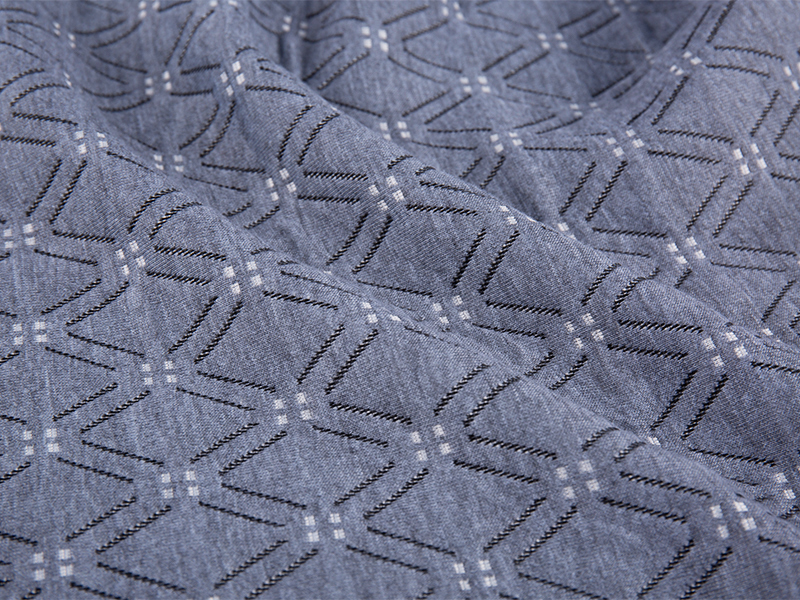
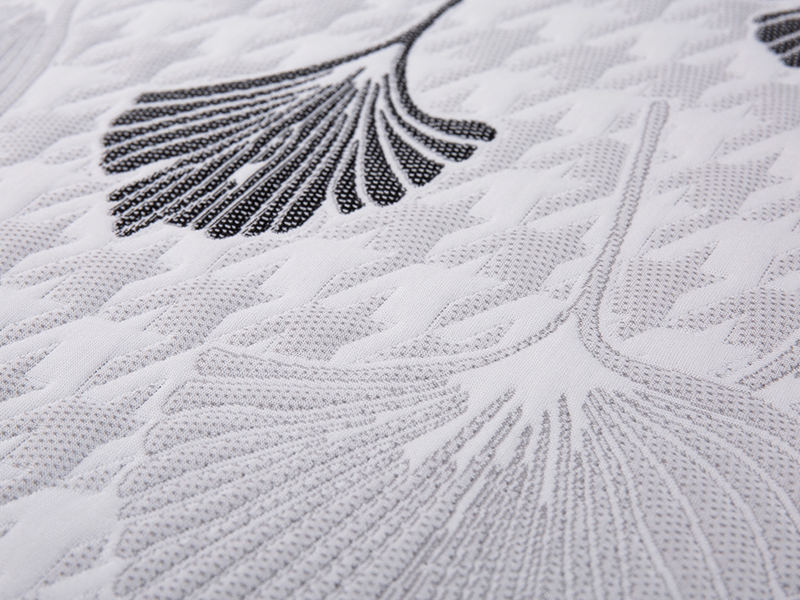 Woven Jacquard Mattress FabricWoven with individual warp control so patterns come from colored yarns rather than surface printing, keeping designs visible on both sides. It fits here as a specification example for premium programmes where yarn-dyed colorfastness matters over the mattress lifespan.View Product →
For premium programmes, woven jacquard deserves its own lines: pattern repeat size, ground and effect yarns, and whether the design is yarn-dyed or printed. Yarn-dyed jacquard costs more upfront but holds its colour through the life of the mattress far better than surface printing.
Performance Grades That Prevent Delivery Disputes
Performance grades turn subjective quality arguments into pass-or-fail test results. For each property, name the test method, the grade, and the sampling point, and both sides can verify the result at any laboratory.
Four tests carry most of the weight in mattress fabric. Abrasion resistance to ISO 12947-2 (Martindale) should reach 15,000 to 20,000 cycles for residential ticking and 25,000 or more for hotel programmes. Pilling resistance to ISO 12945-2 is normally graded 3-4 or better after 2,000 cycles. Colorfastness to washing and rubbing under ISO 105-C06 or AATCC 8 should hit grade 4, with grade 4 also the sensible floor for light exposure. Dimensional change after three wash cycles should stay within 3 percent.
Safety and Compliance Specifications
Compliance parameters are set by law in the destination market, so they belong in the RFQ as requirements, not preferences.
Flammability standards
State the destination and the applicable standard: 16 CFR Part 1633 for mattresses sold in the United States, BS 7177 for the UK, and EN 597-1 and EN 597-2 across much of Europe. Make clear whether flame-retardant performance must be built into the fabric itself, through inherent FR fibres or a non-chemical FR treatment, or handled by the mattress builder with a fire sock. Ambiguity here is expensive, because a fabric that passes one regime can fail another.
Chemical compliance
For export programmes, require Oeko-Tex Standard 100 certification and REACH compliance as conditions of quotation. Professional mills treat this as routine: Hangzhou Xiaoshan RongLi holds ISO 9001 quality certification, tests its fabrics against EU REACH requirements, and carries Oeko-Tex Standard 100 certification, so requesting these documents in the RFQ simply filters for suppliers of that standing.
Functional Claims: Cooling, Waterproofing, and Hygiene
Every functional claim needs a number and a test method, or it cannot be enforced at delivery. Functional fabrics justify price premiums, which makes them the first place disputes appear when the RFQ was silent on measurement.
- Cooling: specify a Qmax value, commonly 0.15 W/cm2 or higher on finished fabric, measured to ISO 11092 or JIS L 1927, plus retention after 10 to 30 wash cycles; for graphene or phase-change options, state the intended mechanism too
- Waterproofing: give a hydrostatic head, for example 1,000 mm or higher, plus lamination details such as a TPU film of 20 to 40 g/m2 and whether the membrane uses solvent-free adhesives
- Hygiene: for antimicrobial or antistatic finishes, require a reduction rate of 90% or more under AATCC 100 or ISO 20743 and name the durability requirement, such as performance after 20 washes
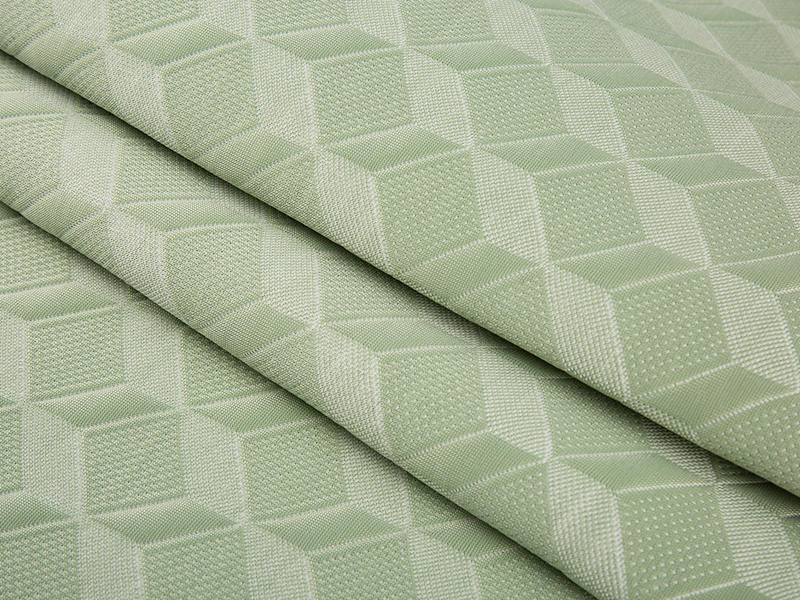 Cool Touch Mattress FabricKnitted fabrics using HDPE or mica-infused yarns with Q-max values reaching 0.25-0.45 for rapid heat transfer on contact. A functional claim like cooling requires stated numbers and test methods, making this a fitting example where measurable performance justifies the price premium.View Product →
Baby programmes combine all three families: a waterproof membrane, washable construction, and certified materials. Write the hydrostatic figure, the wash cycle count, and the chemical certification into the same line item so the supplier cannot treat them as optional extras.
 Waterproof Baby Mattress FabricA TPU-laminated barrier fabric that blocks liquids while staying breathable, washable, and certified for skin contact. It illustrates why hydrostatic figure, wash cycle count, and chemical certification belong in one line item for baby sleep programmes.View Product →
Commercial Terms to Lock Before Sampling
A technically perfect RFQ still leaks money if commercial terms are left to the proforma stage. Five terms belong in the first document:
- MOQ and price validity: state annual volume, per-order minimums, and colourways per design, then ask the quote to stay valid for 30 to 60 days
- Sampling route: name the stages, lab dip, strike-off, counter-sample, and pre-production sample, and agree who pays for each
- Lead time: request the production window from approved counter-sample, not from order date, so sampling delays cannot hide inside the schedule
- Tolerance and inspection: attach the acceptance windows from the technical sheet and set an AQL level, commonly 2.5, for inspection
- Packaging: roll length, inner tube, poly bag, labelling, and pallet configuration for the destination port
Frequently Asked Questions
What GSM should I write into a mattress fabric RFQ?
Match the construction: knitted ticking usually falls between 180 and 320 GSM, woven jacquard between 240 and 380 GSM, and baby mattress knits between 160 and 240 GSM. Always add a tolerance, typically plus or minus 5 percent, so inspection has a pass-or-fail window instead of an opinion.
Which certifications should the RFQ require?
For most export programmes: Oeko-Tex Standard 100 for chemical safety, REACH compliance for the European Union, ISO 9001 for the supplier's quality system, and a flammability standard matched to the destination, such as 16 CFR Part 1633 for the United States or BS 7177 for the UK.
How do I verify a cooling claim before ordering?
Ask for Qmax data measured to ISO 11092 or JIS L 1927, with a value of at least 0.15 W/cm2 on the finished fabric, plus retention figures after repeated washing. Confirm the claim on a counter-sample through a third-party laboratory before releasing bulk production.
Which parameter is most often missing from RFQs?
Tolerance. Buyers list target values for GSM, width, and shade but omit acceptance windows, which leaves inspectors without a pass-or-fail rule and turns delivery disputes into negotiations. A tolerance of plus or minus 5 percent on GSM and 2 cm on width resolves most cases in advance.