 English
 русский
 Español
 中文简体
中文简体
Article Directory
- 1 What Dimensional Stability Means in Mattress Fabric
- 2 Fiber-Level Factors: Moisture Regain Sets the Ceiling
- 3 Yarn and Fabric Structure: Construction Controls the Damage
- 4 Finishing Treatments: Where Stability Is Locked In
- 5 Wash Conditions and Test Protocol: Match the Test to Real Use
- 6 How to Write a Washability Specification That Works
- 7 Washability FAQ
A mattress ticking fabric with 9% weft-wise shrinkage will destroy a production run. Within the first 120 rejected cover panels, the pattern is always the same: edges wrinkle, quilting puckers, and the cover pulls away from the foam core. Any manufacturer selling washable mattresses, baby mattress covers, or removable ticking faces this risk the moment a fabric is approved without checking dimensional behavior. This guide explains the fiber, construction, finishing, and wash-condition factors that decide whether a mattress fabric holds its shape after repeated laundering.
What Dimensional Stability Means in Mattress Fabric
Dimensional stability in mattress fabric is the fabric's ability to keep its original length, width, and surface flatness after repeated washing and drying, and it is always expressed as a number per direction.
Suppliers report it as percentage change in the warp and weft directions after a defined number of wash cycles; a negative value means shrinkage, a positive value means growth. For mattress producers, the critical gap is between the cover's movement and the foam core's movement, because foam does not shrink. A cover that moves 3% while the core stays fixed creates edge curl, tape detachment, and an uneven sleeping surface.
In baby mattress applications, this is not a durability extra. Parents wash covers at 60°C or higher, often weekly, and a cover that migrates 2-3% changes the fit on the pad and exposes edges. Washable baby ticking is therefore treated as a safety-adjacent specification.
Fiber-Level Factors: Moisture Regain Sets the Ceiling
At the fiber level, moisture regain is the strongest single predictor of how much a mattress fabric will shrink in washing.
Cotton, bamboo, and lyocell: cellulosic fibers move with water
Cotton has a moisture regain of about 7-8%; bamboo and lyocell sit higher, in the 9-11% range. During washing, water enters the amorphous regions of the fiber, swells it, and allows it to relax into a shorter, wider configuration. Unfinished cotton ticking can lose 4-6% in the first wash; compacted and resin-treated constructions hold at 1.5-2.5%.
For production-side controls such as compacting ratio and resin selection, see our guide to reducing shrinkage and pilling in cotton mattress fabric production.
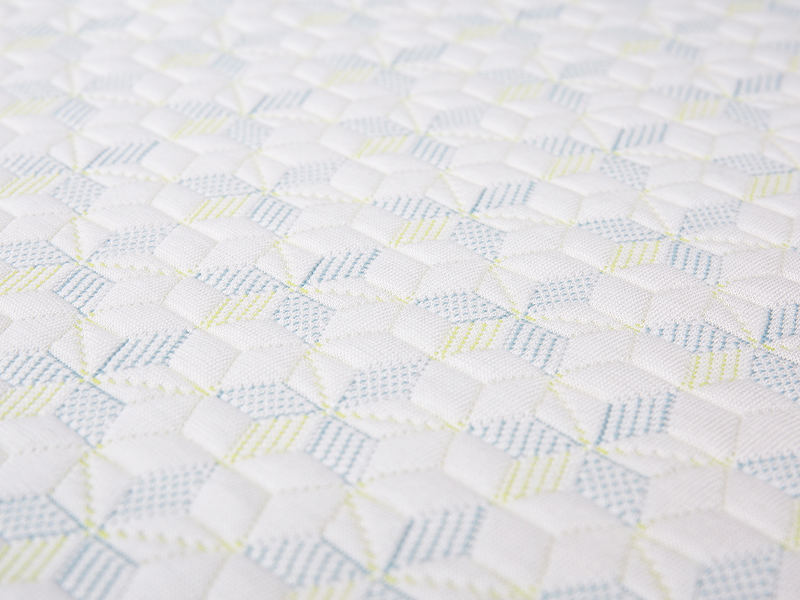 Cotton Mattress Fabric with Shrinkage Control for BeddingThis cotton mattress fabric category includes 3D textured and standard ticking options with sanforized finishing for dimensional stability. Its breathable, moisture-absorbing properties make it suitable for residential, hospitality, and healthcare bedding.View Product →
Polyester and its variants: the dimensionally quiet fiber
Polyester's moisture regain is about 0.4%, which leaves water almost nothing to enter; its behavior is set by structure and heat history instead. Heat setting at 180-200°C after dyeing fixes yarn crimp and loop geometry, and a properly heat-set polyester ticking typically shows under 1% warp-wise change after five washes. Functional variants such as Coolmax and graphene polyester follow the same rule.
 Polyester Mattress Fabric with Heat-Set Dimensional StabilityEngineered polyester mattress fabric offers low moisture regain and high abrasion resistance. Heat-set finishing ensures warp-wise change below the stated threshold after washing, while specialized variants add pest barrier or fragrance features for diverse bedding needs.View Product →
Blends: trading absorbency for predictability
Poly-cotton blends sit between the two extremes. A 50/50 blend keeps some of cotton's hand feel while cutting the shrinkage ceiling roughly in half, which is why 35-50% cotton content is the common working range for washable mattress ticking.
Cumulative dimensional change by wash cycle
Yarn and Fabric Structure: Construction Controls the Damage
Yarn twist, stitch density, and the geometry of a knit or woven structure decide how much of the fiber's shrinking potential becomes actual fabric movement.
Yarn twist and count
Higher-twist yarns hold fibers together tightly, leaving less room for water to enter and fibers to reorient. Low-twist open-end yarns, common in economy ticking, relax quickly in hot water and produce uneven shrinkage across the roll. Finer, more uniform yarns distribute stress evenly, while coarse irregular yarns create weak points where distortion starts.
Knit versus woven geometry
Knitted structures move more because every loop is a potential hinge. Weft-knit single jersey is the least stable construction, while double knits and textured-polyester knits recover better. Woven structures are inherently more locked, but not all weaves are equal: plain and twill hold well, while satin weaves are prone to skew because long floats shift under mechanical action.
Weft-knit ticking
- Stretch and drape absorb movement in loops
- Needs compacting and dense stitch structure
- Typical 2-4% change after five washes
- Better for quilted comfort layers and covers
Woven ticking
- Low extensibility, yarns locked by interlacing
- Sensitive to skew in long-float weaves
- Typical 1-2.5% change with pre-shrunk finishing
- Better for structured, durable mattress ticking
GSM without stitch density is a misleading spec
A 320 gsm fabric with loose loops can shrink more than a 240 gsm fabric with a dense stitch pattern. GSM describes weight, not structural tightness. Add loops per centimeter for knits or yarns per centimeter for wovens to the technical datasheet.
Finishing Treatments: Where Stability Is Locked In
Compacting, heat setting, and resin cross-linking are the three finishing operations that convert a fabric's shrinking potential into a controlled, testable number.
Wet finishing leaves most fabrics stretched and relaxed; without stabilization, the first wash releases that internal stress.
- Compacting: a rubber-belt compactor mechanically compresses the fabric in the warp direction, reducing residual shrinkage to a declared range such as 1-3%.
- Heat setting: polyester and polyester-blend fabrics are heated to 180-200°C to fix yarn crimp and loop shape so the structure cannot reorient in water.
- Resin cross-linking: cotton-rich fabrics are treated with cross-linking resins, preferably formaldehyde-free formulations, to limit fiber swelling and lock the weave geometry.
Hangzhou Xiaoshan RongLi Clothing Co., Ltd. (RongLi) manufactures mattress ticking across weaving, dyeing, and finishing under one roof, with Oeko-Tex Standard 100 certification and EU REACH compliance testing. Vertical integration matters for washability because the stabilization process runs from yarn selection to final inspection, not through one isolated machine.
Wash Conditions and Test Protocol: Match the Test to Real Use
Water temperature, mechanical action, drying mode, and cycle count determine whether a laboratory test predicts what a consumer's washing machine will do.
A stability figure is meaningless without its test conditions; the table below lists the control points that should appear on every washability datasheet.
| Variable | Typical range | Effect on dimensional stability | What the buyer should specify |
| Water temperature | 40 C, 60 C, 90 C | Higher heat accelerates fiber swelling and stress relaxation | Set the temperature to the finished product care label |
| Machine type | Front load, top load, industrial washer-extractor | Mechanical action adds fabric stress and accelerates relaxation | Name the machine type and wash program |
| Drying method | Line dry, low tumble, high tumble | Heat and tumbling repeat stress on wet fibers | Fix the drying mode and maximum drying temperature |
| Cycle count | 1, 3, 5, 10, 20 | Dimensional change accumulates and then plateaus | Require a minimum of 5 cycles for acceptance testing |
| Measurement | ISO 5077, AATCC 135 | Conditioning and marking method affect the result | Reference the standard and the conditioning procedure |
Measurement standards such as ISO 5077 for dimensional change in washing and drying, and AATCC 135 for home laundering, define the marking, washing, and conditioning procedure. The product specification should state which standard applies and at what temperature.
Buyers who need auditable wash data prefer a mattress fabric manufacturer that links every roll to its heat-setting and compacting records; a single supplier shortens the audit trail from fiber to finished roll.
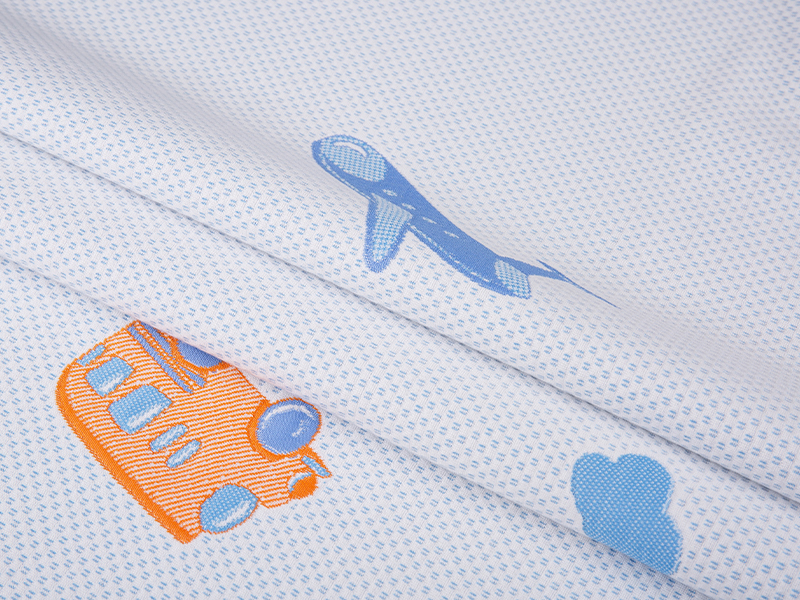 Machine Washable Mattress Fabric for Frequent CleaningDesigned for repeated laundering up to 60°C, this removable cover fabric resists pilling and maintains dimensional stability. Its breathable barrier suits memory foam, hospital, hotel, and crib mattress applications requiring hygiene and rapid turnover.View Product →
How to Write a Washability Specification That Works
A washable mattress fabric specification must state the test method, wash temperature, cycle count, drying mode, and maximum permitted warp and weft dimensional change as separate numbers.
Vague language such as good washing performance or minimal shrinkage has no place in a datasheet. The sequence below turns washability into measurable acceptance criteria.
- Define the wash program. Cite ISO 5077 or AATCC 135 with the machine type, wash temperature, and drying mode.
- Set per-direction limits. For example, warp change no more than 3% and weft change no more than 3% after 5 cycles.
- Add a skew limit. Diagonal distortion should stay within 2% so quilting and tape edges do not drift.
- Require finishing declarations. The supplier must state whether the fabric is pre-shrunk, compacted, heat-set, or resin finished.
- Confirm chemistry compliance. Wet additives and finishes must meet Oeko-Tex Standard 100 and EU REACH input limits.
- Validate on the complete mattress construction. Washing a flat fabric sample does not reproduce the tension of a quilted, taped cover.
| Wash program | Max warp change | Max weft change | Max skew |
| Home wash, 40 C, 5 cycles | 3% | 3% | 2% |
| Commercial wash, 60 C, 5 cycles | 2.5% | 2.5% | 1.5% |
| Premium program, ISO 5077, 60 C, 10 cycles | 2% | 2% | 1% |
Washability FAQ
What is a good dimensional stability limit for washable mattress fabric?
For washable mattress covers and baby mattress ticking, a warp and weft change of no more than 3% after five wash cycles at the labeled temperature is a solid production limit. Premium programs target 2%.
Does higher GSM make a mattress fabric wash more stably?
No. GSM is a weight measurement, not a stability measurement. A loose 320 gsm knit can shrink more than a compact 240 gsm knit. The specifications that predict stability are stitch density, yarn twist, and finishing state.
Why does cotton ticking shrink more on the second wash than on the first?
Residual finishing tension keeps the fabric stretched after production, so first-wash results can look better than the fabric actually is. Once that tension relaxes, the second and third washes reveal the true structure behavior.
Can 100% cotton mattress ticking be made wash-stable?
Yes. Compacting, resin cross-linking, high yarn twist, and dense construction can bring 100% cotton ticking to under 2% warp shrinkage after multiple washes, but the stability has to be engineered from the yarn stage.