 English
 русский
 Español
 中文简体
中文简体
Article Directory
Buying a mattress fabric named after a food crop raises a practical question: what, exactly, are you specifying? Soy fiber mattress fabric is a regenerated plant protein fiber, not a synthetic imitation of soy. For a bed manufacturer evaluating it for a new collection, the decision comes down to moisture handling, durability, and how the fabric behaves on the quilting line.
The sections below cover the key material properties, the blend ratios that make them usable in a mattress, and the verification steps that protect a production order. The values quoted are typical commercial ranges, not marketing numbers.
What Soy Fiber Mattress Fabric Actually Is
Soy fiber mattress fabric is a textile whose yarn contains regenerated soybean protein fiber, a plant-derived fiber produced from the soybean meal left after oil extraction and blended with a film-forming polymer so it can be spun.
The production route starts with defatted soybean meal. Soy protein is isolated, dissolved in alkali, and wet-spun together with polyvinyl alcohol. The resulting staple carries 20-30 percent protein by mass, and the carrier polymer makes up the rest. That structure gives the yarn a soft, matte, wool-like hand, while retaining enough processability to be knitted, woven, and dyed.
For bedding brands, the practical starting point is a mill that controls the entire route from yarn to finished ticking. Hangzhou Xiaoshan RongLi Clothing Co., Ltd. does exactly that, with in-house design, weaving, and finishing at a 100,000-square-meter plant in Hangzhou.
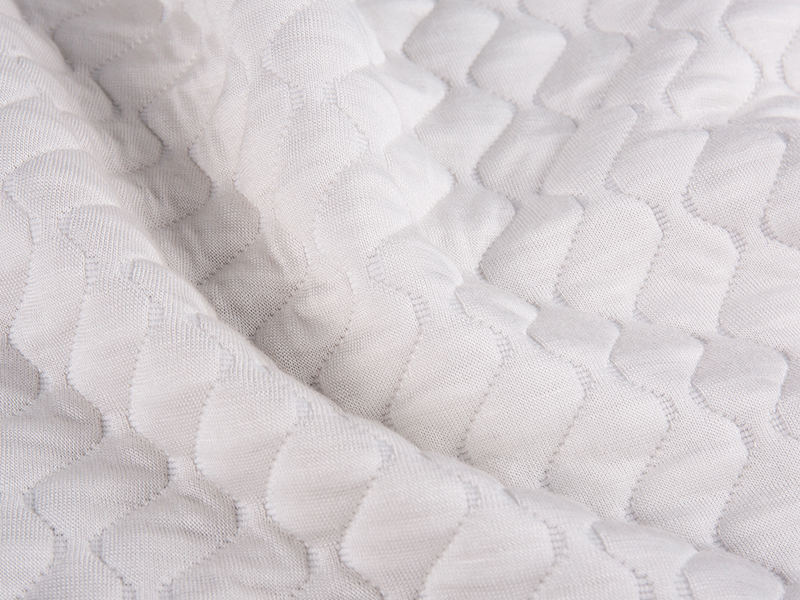 Soy Fiber Mattress Fabric from Vertically Integrated MillA bio-based textile with 10-12% moisture regain, offering natural breathability and skin-compatible properties. The supplier controls yarn-to-ticking production, making the material a credible option for bedding brands evaluating sustainable fiber performance.View Product →
Moisture Regain and Thermal Behavior
On the metrics that matter for sleep comfort, soy fiber performs like a natural fiber rather than a synthetic one: moisture regain sits at 8-10 percent, in the same band as cotton and far above polyester.
Moisture regain is the percentage of water a bone-dry fiber reabsorbs at standard temperature and humidity. Amino groups in soy protein attract water vapor, so a knit layer next to the skin absorbs and releases perspiration instead of trapping it. Fabrics feel less damp, and drying is faster; at fabric level, that reads as breathability and moisture-vapor transfer.
Thermal behavior needs a separate check. Soy fiber does not produce a high Q-max cool-touch value on its own; its contribution to sleep temperature comes from moisture transport. A dry skin-contact layer allows evaporative heat loss to proceed, so a soy blend cover feels cooler than a damp synthetic one under the same conditions. Manufacturers that need a labeled cooling claim pair soy knits with phase-change or cool-touch finishing.
Soy fiber is breathable, but a marketable Q-max number comes from cool-touch finishing or engineered filaments. Ask for the Q-max test report the same way you would for a polyester cool-touch fabric.
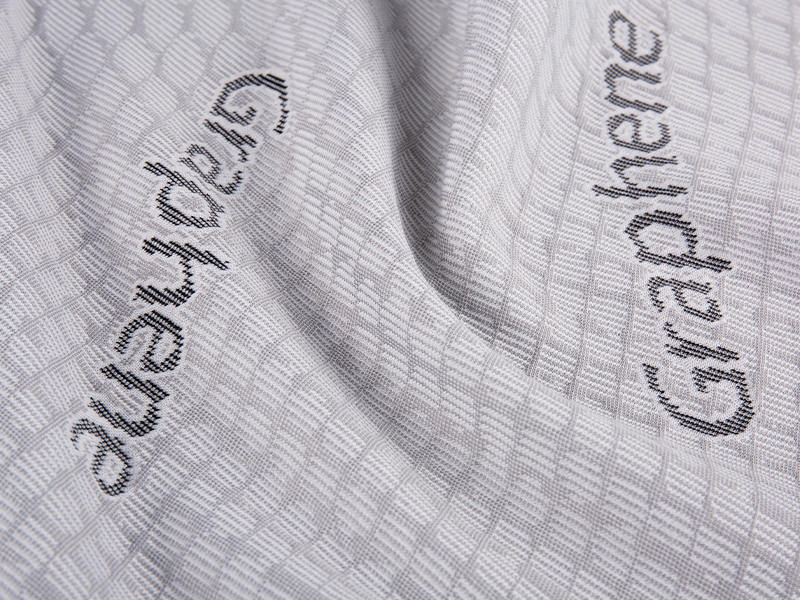 Phase Change Material Mattress Fabric with Customizable PCM ContentThis fabric uses PCM microcapsules to absorb and release heat, reducing skin temperature fluctuation by 3-5°C. It suits cooling mattress lines, but requires a Q-max test report to verify its cool-touch effect before specification.View Product →
Mechanical Behavior and Blend Ratio
Unblended soy protein fiber cannot survive the abrasion cycle of a mattress cover on its own; usable mattress ticking starts at a 30/70 soy-to-carrier blend and reaches about 50/50 before pilling becomes a service risk.
Commercial soy staple shows dry breaking tenacity of roughly 3.0-4.5 cN/dtex, but wet tenacity drops, and the soft fiber surface pills under repeated friction. A mattress top panel endures daily body contact, sheet friction, and edge abrasion. Blending with polyester raises dry strength and dimensional stability; blending with cotton increases absorbency. The ratio you choose changes wear-test results enough to move a fabric from one contract grade to another.
| Property | Typical range | Relevance in a mattress |
| Fiber fineness | 1.2-1.5 dtex | Evenness of the knit surface and perceived softness |
| Moisture regain | 8-10% | Perspiration absorption and breathability |
| Dry tenacity | 3.0-4.5 cN/dtex | Quilting strength and seam behavior |
| Wet tenacity | 2.0-2.8 cN/dtex | Durability through laundering |
| Pilling rating, blended knit | 3-4 on a 1-5 scale | Surface retention under repeated friction |
| Wash shrinkage, heat-set finish | Max 3% | Dimensional stability of removable covers |
| Fabric weight | 180-320 g/m2 | Drape, quilting body, and cover construction |
A practical consequence: if you are quilting a soy-blend knit over memory foam, specify the fabric weight before lamination. The same knit at 200 g/m2 behaves differently under a deep quilting pattern than at 280 g/m2 because the heavier weight controls foam show-through and stitch sink.
100% Soy Staple
Maximum protein softness and absorbency, but lower wet strength and faster pilling. Best reserved for a quilted comfort layer protected by a stronger outer ticking, not for the wear surface of a heavy-use mattress.
Soy-Polyester Blend
The standard commercial form for mattress fabric. Polyester raises dry strength, abrasion resistance, and dimensional stability while the soy share preserves softness and moisture absorption. Recommended for ticking and removable covers.
A label that says "soy" does not tell you the protein percentage. A 15% protein content performs very differently from a 30% one. Confirm the blend ratio on the technical datasheet and test the head cloth before approving production.
Application Requirements on the Production Line
To pass production, soy fiber mattress fabric must meet five application requirements: dimensional stability under quilting, pilling resistance on the wear surface, compatibility with lamination and flame barriers, machine-wash tolerance in removable covers, and consistent GSM across rolls.
- Dimensional stability. Heat-set knitting and finishing must hold shrinkage at or below 3 percent. Quilting stretches fabric, so specify a balanced knit structure or a laid-in synthetic filament when the cover is heavily quilted.
- Quilting performance. Yarn elongation at break of 15-25 percent lets the fabric follow a multi-needle quilting head without tearing. Require a minimum seam strength for the sewn panel.
- Abrasion and pilling. Blended structures should reach at least 20,000 Martindale rubs for residential use; discuss a higher grade for hospitality and contract programs.
- Lamination and flame-barrier compatibility. Soy fabric is not a flame barrier. The finished mattress must pass CFR 1633 or BS 7177 with the intended barrier layer; confirm that lamination adhesive and FR treatment do not embrittle the knit.
- Wash tolerance for removable covers. Repeated laundering attacks protein-based fibers more aggressively than pure polyester. Require a wash report and keep the soy share below 50 percent when the cover is machine-washable.
In practice, the same material is specified for cooling mattress collections with a functional knit finish, for baby mattress covers when certifications allow skin-contact claims, and for mid-market sustainable lines where the eco-story supports the sell.
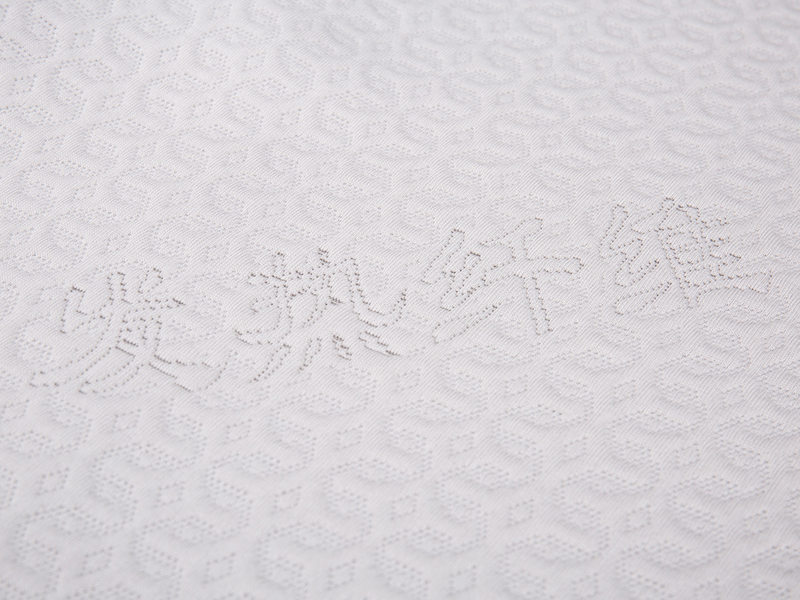 Soft Knit Mattress Fabric in Elastic Loop ConstructionCircular-knit fabric with bi-directional stretch that conforms to mattress contours without extra elastic. It fits cooling collections, baby covers, or sustainable lines, but orders depend on OEKO-TEX, REACH, and wash-wear documentation.View Product →
What to Verify When Sourcing Soy Fiber Mattress Fabric
A defensible soy fiber mattress fabric order rests on certifiable paperwork: an Oeko-Tex Standard 100 certificate covering the finished fabric, a REACH compliance statement, a declared blend percentage, and a wash-wear report for shrinkage and pilling.
A trading name tells you little. A mill that can show its production route and a stable recipe is the more predictable partner. RongLi's export documentation is in regular use because its ticking ships to Europe, the United States, Southeast Asia, the Middle East, Japan, and Korea, and the plant holds ISO 9001 quality-system certification.
Before finalizing a specification, read how soy fiber balances environmental appeal and comfort in mattress materials to benchmark your requirements against a complete comparison.
- Weigh and measure the head cloth: confirm GSM and thickness against the declared 180-320 g/m2 band. A wrong GSM usually signals inconsistent finishing or a substituted yarn.
- Run a manual pilling screen: rub the sample against your reference swatch under the same pressure and inspect the surface after 50 strokes.
- Review batch dye limits: confirm the AQL for the color lot, especially when the cover panel borders white quilting, where migration is visible.
Oeko-Tex Standard 100 and EU REACH compliance documents should travel with every production lot. Ask for them before price negotiation, not after.
Frequently Asked Questions
Three questions come back often when purchasers evaluate soy fiber ticking. Answers below use the same typical commercial ranges cited in the rest of this article.
What is the typical soy fiber content in mattress fabric?
Commercial soy staple carries 20-30 percent soy protein; after blending, the soy share in the yarn is usually 30-50 percent. Verify the actual percentage on the datasheet because it controls absorbency, hand feel, and wear performance.
Does soy fiber mattress fabric keep sleepers cool?
It supports cooling by transporting moisture vapor and keeping the skin-contact layer dry, but it does not produce a labeled Q-max cool-touch effect. A cooling claim relies on finishing, so request a Q-max report if that is your intended claim.
Can soy fiber mattress covers be machine washed?
Removable soy-blend covers tolerate gentle machine washing when heat-set finishing has stabilized them. Confirm a wash report showing shrinkage below 3 percent before approving the design.
How should buyers check soy fabric quality before a production order?
Request Oeko-Tex Standard 100 and REACH documentation, verify the blend ratio and GSM on the head cloth, and run a pilling and shrinkage check against your reference swatch before committing.