 English
 русский
 Español
 中文简体

Article Directory
Three documents decide whether a mattress fabric can be sold as sustainable: the fiber origin record, the certificate scope, and the construction test report. Buyers who request all three before sampling avoid the most expensive mistake in this category, which is paying a certified fiber premium for a fabric whose certificate never covered the fiber it was built from.
Regulation has caught up with the marketing. Directive (EU) 2024/825, which European Union member states must transpose by 27 March 2026 and apply from 27 September 2026, bans environmental claims that cannot be backed by recognised evidence. For a mattress manufacturer, that turns fabric sourcing into a documentation exercise. A supplier who hands over a GOTS transaction certificate, an Oeko-Tex Standard 100 certificate number and a Martindale abrasion report in one folder is worth more than one quoting a lower price per metre.
Hangzhou Xiaoshan RongLi Clothing Co., Ltd. has produced mattress fabric in Xiaoshan, Hangzhou since 1989 from a 100,000 square metre facility, and works to that documentation standard: ISO 9001:2000 for process control, EU REACH testing across the range, and Oeko-Tex Standard 100 certification as a baseline for export orders into Europe, the United States, Japan and South Korea.
Fiber Origin Decides the Claim Before Any Certificate Does
Fiber selection fixes most of a mattress fabric's environmental profile, and certification can only confirm what the fiber already is. Two tickings at 300 GSM can look identical, feel identical and carry the same Oeko-Tex certificate number while one is spun from organic cotton and the other from a conventional blend. Nothing on the certificate distinguishes them, because the certificate was never designed to test that question.
Start the audit at the yarn, then move forward through weaving, dyeing and finishing. A buyer who inverts that order ends up negotiating price on a fabric whose sustainability story cannot survive a single question about where the cotton came from.
| Fiber | Verification route | What it changes | Sourcing risk |
| Organic cotton | GOTS plus Oeko-Tex Standard 100 | Removes synthetic pesticide and fertiliser inputs and requires a segregated spinning chain | Certified lint supply is thinner than demand and prices move faster than conventional cotton |
| Conventional cotton | Oeko-Tex Standard 100 only | No change to agricultural inputs | Low, and the claim ceiling is equally low |
| Lyocell (regenerated cellulose) | Oeko-Tex Standard 100 plus FSC or PEFC pulp chain of custody | Solvent is recovered inside a closed loop in the lyocell route | Fewer spinners, longer lead times on specialty counts |
| Bamboo viscose | Oeko-Tex Standard 100 | Environmental performance depends on the mill's solvent recovery rate, which the certificate does not disclose | Bamboo claims are frequently unverifiable at fabric level |
| Recycled polyester | GRS plus Oeko-Tex Standard 100 | Diverts post-consumer bottle waste and reduces virgin polymer demand | Chain of custody has to be verified batch by batch |
For the cotton route specifically, the practical starting point is a supplier who already publishes construction data alongside the fiber data, such as the mill's 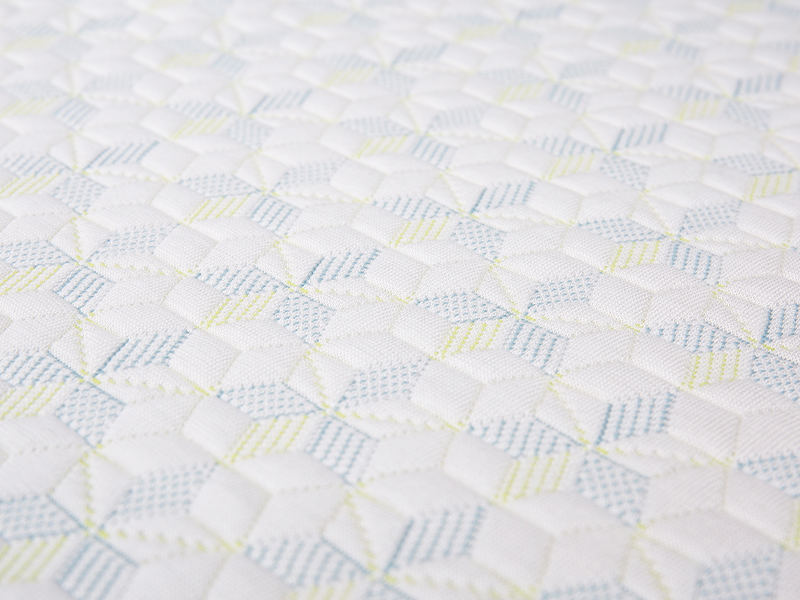 Cotton Mattress Fabric Range for Ticking SourcingCompare five cotton ticking constructions here before matching yarn count, fiber claims, and certification scope with a supplier.View Product → cotton program, because the yarn count and the fiber claim then sit on the same document.
Read the Certificate Scope, Not the Logo
Oeko-Tex Standard 100 verifies that a finished textile holds no harmful substances above defined limit values, and it verifies nothing at all about fiber origin. GOTS and Oeko-Tex Standard 100 answer two different questions, and treating them as interchangeable is the most common sourcing error in this category.
A ticking with a valid Oeko-Tex certificate number can still be woven from conventional cotton grown with synthetic pesticides. The certificate is genuine, the laboratory test is genuine, and the fiber behind it is unchanged. A buyer who needs an organic claim has to layer a fiber-level certificate on top of the product-level test instead of substituting one for the other.
| Certificate | What it verifies | What it does not cover |
| Oeko-Tex Standard 100 | Harmful substance content of the finished article against annual limit values, in four product classes with Class I for baby articles | Fiber origin, farming practice and working conditions |
| GOTS (Global Organic Textile Standard) | Organic fiber content of 70% minimum for the made with organic label and 95% for the organic grade, plus chemical inputs, wastewater treatment and social criteria | Non-textile components such as thread, zips and packaging |
| EU REACH | Declaration of any SVHC present above 0.1% w/w in an article, plus Annex XVII restrictions on named substances | Fiber composition and anything resembling a sustainability claim |
| ISO 9001:2000 | That the mill runs a documented, auditable quality management system | Any physical property of the fabric itself |
| GRS (Global Recycled Standard) | Recycled input at 20% minimum and chain-of-custody records through each processing step | Natural or organic fiber claims |
A supplier that prints the certificate class next to the construction, as the Oeko-Tex approved sleep fabrics range does, removes an entire round of sampling questions before the first sample is even cut.
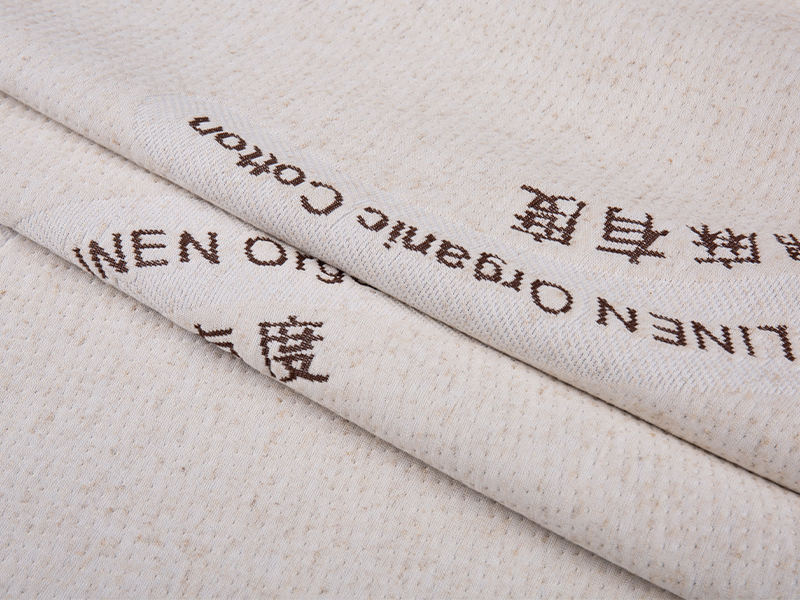 Organic Cotton Mattress Fabric for Certified TickingReview certified organic cotton ticking in knit or jacquard constructions, with GOTS/OEKO-TEX options and 200–450 GSM for mattress service.View Product →
Construction and Weight Decide Whether the Claim Survives Year Ten
Knitted ticking between 240 and 350 GSM and woven jacquard between 300 and 450 GSM are the two construction families that hold up in mattress service. Below 240 GSM, cover fabrics lose shape faster than a standard warranty cycle allows, and a sustainability claim resting on a failed cover becomes a warranty cost rather than a marketing asset.
Construction also changes how the fabric interacts with the layers underneath. A knit stretches over foam and conforms to the quilting profile, while a woven jacquard holds its geometry and carries pattern detail that supports a premium price position. Neither is automatically more sustainable; the fiber inside them decides that.
- Stretches over foam and pocket-spring units without bridging
- Higher air permeability for the same weight
- Softer hand feel at 240 to 320 GSM
- Pilling risk rises when low-grade spun yarn is used
- Dimensional stability under repeated load
- Higher abrasion resistance in the 320 to 450 GSM band
- Supports complex patterns for premium positioning
- Lower stretch, so quilting allowances must be recalculated
A mill running both families on imported weaving equipment can move a specification between them without changing fiber suppliers, which keeps the certified yarn chain intact when a retailer requests a knitted version of an approved woven cover. A soft knit route built on the same certified yarn is one example of how that switch is handled in practice.
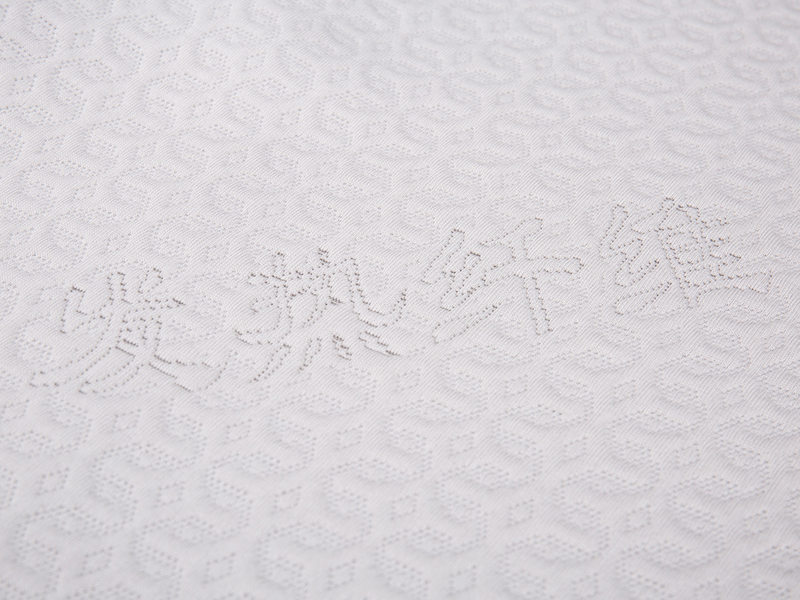 Custom Soft Knit Mattress Fabric for Stretch CoversReview circular-knit ticking for stretch-fit covers, with elastic recovery and breathability, plus durability and safety testing relevant when moving from woven covers.View Product →
Request Six Test Reports With Every Sample
Six reports cover the durability and safety questions that decide whether a sustainable ticking can actually be used: abrasion under ISO 12947-2, pilling under ISO 12945-2, dimensional stability under ISO 6330, colour fastness to rubbing under ISO 105-X12, air permeability under ISO 9237, and flammability under 16 CFR 1633 or BS 7177.
| Property | Method | Threshold to specify | Failure mode if skipped |
| Abrasion resistance | ISO 12947-2, Martindale | 20,000 rubs for residential covers, 40,000 for contract and hospitality | Surface wear and broken yarns inside the warranty period |
| Pilling | ISO 12945-2 | Grade 4 or better after 2,000 revolutions | Fiber balls that destroy hand feel on the showroom floor |
| Dimensional stability | ISO 6330 | Shrinkage held within 3% after three domestic wash cycles | Cover distortion and seam stress after laundering |
| Colour fastness to rubbing | ISO 105-X12 | Grade 4 on the grey scale, wet and dry | Dye transfer onto foam, sheets and mattress protectors |
| Air permeability | ISO 9237 | A measured value stated on the technical data sheet, not a description | Heat build-up under the sleeper and returned goods |
| Flammability | 16 CFR 1633 in the United States, BS 7177 in the United Kingdom | No flashover through the 30-minute burner test | Blocked market entry after production is already committed |
Flame performance deserves separate attention because it interacts with fiber chemistry and with the barrier layers underneath the ticking, and non-chemical routes are documented in this note on mattress fabric flammability under CFR 1633 and BS 7177.
Qualify the Supply Chain in Four Steps
Four documents separate a verified sustainable mattress fabric from an unverified one: batch-level fiber certificates, the mill's restricted substances list, construction test reports dated within twelve months, and evidence that certified fiber is physically segregated from conventional fiber through every processing step.
Buyer Questions Before You Sign
These are the four questions that decide most sustainable mattress fabric specifications, and each has a short answer that can be checked against a document rather than a sales claim.
Is Oeko-Tex Standard 100 enough to call a mattress fabric sustainable?
No. It certifies harmful substance content against defined limit values across four product classes, with Class I reserved for baby articles, and it makes no statement about fiber origin or agricultural practice. Pair it with GOTS for organic content or GRS for recycled content, and file the certificate number against the production batch it covers.
How many abrasion cycles should a sustainable ticking pass?
20,000 Martindale rubs under ISO 12947-2 is the working floor for a residential mattress cover, and hospitality programs typically specify 40,000. A ticking that tests below 20,000 rubs should not carry a long-life claim, because the fabric will fail before the cover leaves the warranty window.
What percentage of organic or recycled fiber is needed for a credible label?
GOTS requires a minimum of 70% organic fiber for the made with organic label and 95% for the organic grade, while GRS requires a minimum of 20% recycled input with chain-of-custody records. Below those figures the product has to be described as a blend, and calling it organic or recycled invites exactly the kind of claim that Directive (EU) 2024/825 targets.
Which GSM range keeps a mattress cover breathable?
Knitted ticking between 240 and 350 GSM covers most breathable residential specifications, while woven jacquard above 350 GSM is chosen where the cover has to hold a quilting pattern and resist abrasion. Confirm the result with air permeability testing under ISO 9237 rather than accepting a construction name as evidence.