 English
 русский
 Español
 中文简体
中文简体
Article Directory
A bedding importer once fielded a season of guest complaints about tiny nighttime shocks, crackling sheets, and dust that clung to premium mattress covers in a dry desert market. The mattress cores passed every laboratory test. The insulating synthetic ticking was the real problem: it let static charge accumulate all night until it discharged through the sleeper.
That failure is exactly what conductive mattress fabric prevents. Instead of letting charge build on the sleep surface, a conductive ticking carries it away continuously through conductive yarns knitted into the structure, protecting both comfort and any sensor electronics under the cover.
What Conductive Mattress Fabric Is and How It Works
Conductive mattress fabric works by giving static electricity a continuous, low-resistance escape route, so charge never accumulates to the point of a perceptible discharge.
The engineering is subtler than it sounds. Conductive yarn accounts for only 1 to 2 percent of total fiber content, laid in a stripe or grid pattern a few millimeters apart, so the fabric dissipates charge without changing how the mattress looks or feels.
- Stainless steel fibers blended at low percentages survive laundering and abrasion far better than surface coatings.
- Carbon-loaded filaments hold resistivity stable with a softer hand and no metallic shine under jacquard styling.
- Silver-coated yarns deliver the highest conductivity and suit sensor-driven covers, at a higher cost point.
Because the conductive share is so small, hand feel, drape, and pattern definition stay effectively intact, which matters when the same ticking must carry a premium woven or printed design.
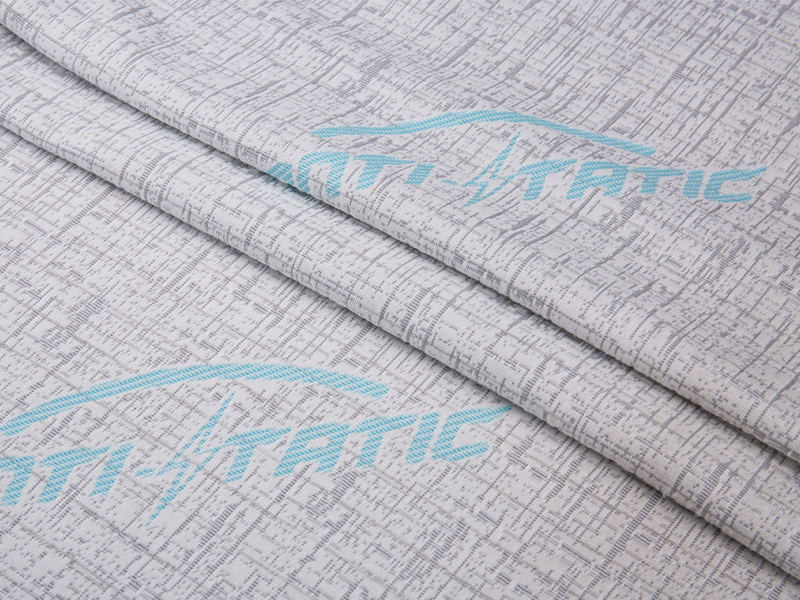 Conductive Mattress Fabric for ESD and Static DissipationWith conductive filaments spun into the yarn, this ticking keeps hand feel and printed designs intact while dissipating static within seconds. Surface resistivity spans 10²–10⁶ Ω/sq, so buyers can match loading to their cover design needs.View Product →
Four Performance Requirements That Separate Fact From Marketing
Surface resistivity, static decay time, wash durability, and certified skin safety decide whether a conductive cover still performs after years of use, not just on the day it arrives.
Surface resistivity targets
Resistivity is the primary specification to negotiate. Conductive-grade fabrics typically measure between 10^3 and 10^6 ohms per square, and EN 1149-1, the European antistatic standard for protective clothing, accepts surface resistance up to 2.5 x 10^9 ohms as a useful reference. For mattress programs, specify a target band rather than a single figure, then require batch-level test reports from the mill.
| Requirement | Benchmark to request | Reference test method | Why it matters |
| Surface resistivity | 10^3 to 10^6 ohms per square for conductive grade | EN 1149-1, AATCC 84 | Sets how quickly charge leaves the surface |
| Static decay time | Under 0.5 seconds from 5,000 V to 50 V | NFPA 99, FED-STD-101C Method 4046 | Predicts real-world shock comfort |
| Wash durability | Resistivity shift within one order of magnitude after 20 to 50 cycles | ISO 6330 laundering sequence | Confirms performance over mattress life |
| Chemical safety | Oeko-Tex Standard 100 and REACH compliance | Oeko-Tex testing, REACH screening | Protects eight hours of nightly skin contact |
Static decay and wash durability
Decay time describes how fast a 5,000 V charge falls to 50 V, and the antistatic benchmark borrowed from healthcare textiles is under 0.5 seconds. Everyday activity generates far larger charges, as the chart shows. Wash durability is where coatings fail: a metalized finish can lose an order of magnitude of conductivity after 20 wash cycles, while conductive yarns spun into the structure hold far steadier. Request paired resistivity readings before and after ISO 6330 laundering.
How Conductive Ticking Compares With Other Functional Fabrics
Conductive ticking solves charge build-up specifically, while graphene, cool touch, and phase-change fabrics target temperature, hygiene, and microclimate, so strong functional mattress lines layer these functions instead of choosing one.
- Primary job: continuous static dissipation and antistatic comfort.
- Keeps dust and hair from clinging to the cover in dry seasons.
- Stable platform for under-cover sensors and smart mattress electronics.
- Primary job: antimicrobial action plus far-infrared thermal effect.
- Conductive grades add antistatic behavior to the same construction.
- Suits premium positioning where hygiene claims drive margin.
For buyers who want both behaviors in one construction, conductive grades of graphene fabric merge antistatic dissipation with antimicrobial performance. Our analysis of graphene mattress fabric antimicrobial and antistatic properties explains how that combination is engineered at the yarn level.
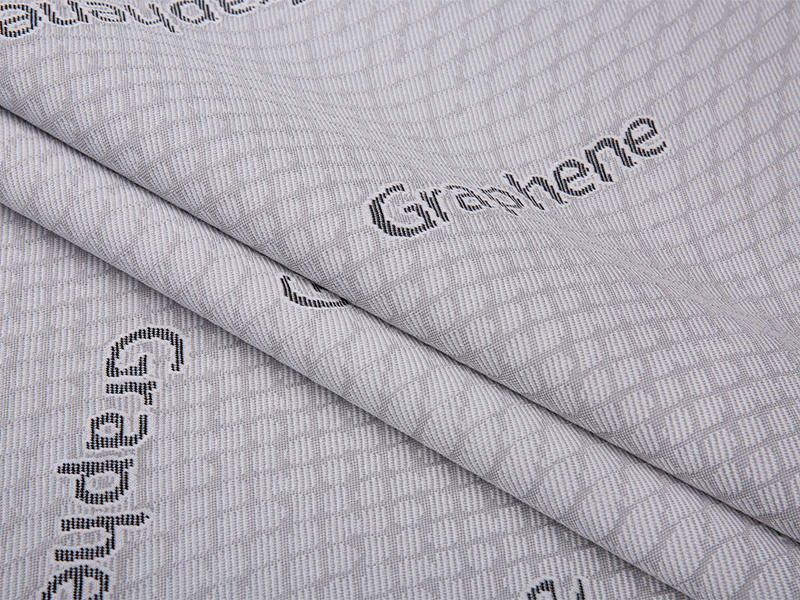 Graphene Mattress Fabric with Antistatic and Antimicrobial ActionFor buyers seeking both static dissipation and hygiene in one construction, graphene-loaded grades pair antibacterial reduction of 99% with fast heat dissipation, retaining performance through repeated industrial laundering cycles.View Product →
A Five-Step Verification Checklist for Mattress Brands
A structured verification process keeps functional covers out of the complaint-and-return cycle that untested fabrics create, and it costs less than handling one season of static complaints.
- Define the electrical target. Set the resistivity band and decay limit based on destination climate and whether sensors sit under the cover.
- Demand paired test data. Require resistivity and decay readings before and after 20 to 50 wash cycles, not a single virgin-sample figure.
- Verify compliance documents. Match Oeko-Tex Standard 100 and REACH reports to the exact fabric article and batch you are buying.
- Trial on your own construction. Quilt or laminate the ticking over your actual foam and spring layout, because adhesives and foam density change dissipation paths.
- Lock tolerances into the contract. Specify resistivity range and decay limit per production lot so every shipment matches the approved sample.
The finished cover format matters as much as the fabric roll, and our guide to how functional mattress ticking covers improve sleep comfort and product performance covers that stage. Sourcing from an integrated mill also shortens the loop: Hangzhou Xiaoshan RongLi Clothing Co., Ltd. has made mattress fabrics since 1989 on imported weaving and knitting machines, holds ISO9001 certification, and supplies Oeko-Tex Standard 100 and REACH documentation with every article, collapsing steps two and three into one sampling request.
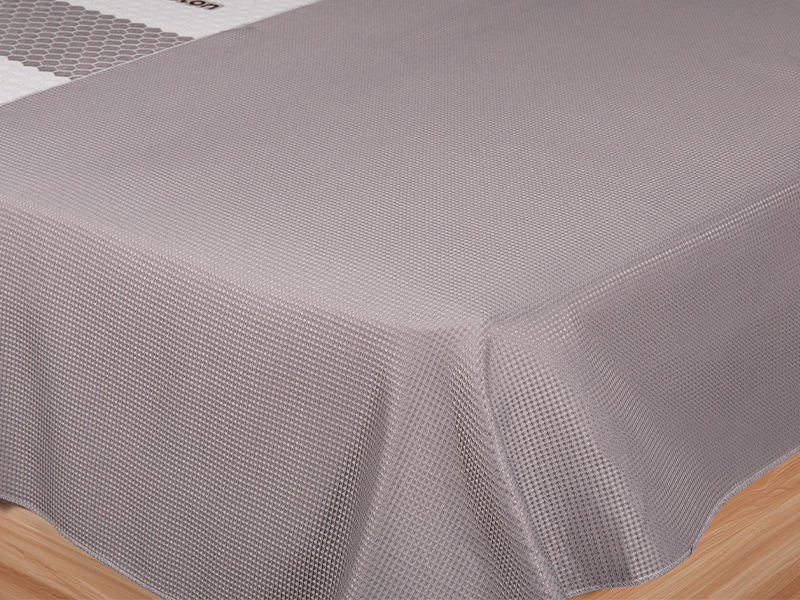 Bamboo/Polyester Mattress Cover Fabric from an Integrated MillSourcing from a mill making mattress fabrics since 1989 shortens sampling and verification. This bamboo-polyester ticking combines moisture-wicking comfort with durable quilting stability, supplied with Oeko-Tex and REACH documentation.View Product →
Frequently Asked Questions
What surface resistivity should conductive mattress fabric have?
Conductive-grade tickings typically measure between 10^3 and 10^6 ohms per square on the yarn network, while the finished cover reading depends on knit structure and finishing. Specify a band and require batch reports rather than a single number.
Does conductive fabric feel different from regular ticking?
Not when it is engineered correctly. A 1 to 2 percent conductive yarn blend leaves hand feel, drape, and pattern definition effectively unchanged; surface coatings are far more likely to alter texture.
Is conductive mattress fabric safe for nightly skin contact?
Yes, when it is certified. Look for Oeko-Tex Standard 100 and REACH compliance on the exact article. The fabric only dissipates existing static charge; it emits nothing and carries no active current in normal use.
Can conductive performance be combined with cooling or graphene functions?
Yes. Conductive yarns integrate into cooling knits and graphene constructions, so one cover can deliver antistatic, cooling, and antimicrobial performance from a single sourcing line.